The best cycling routes around Saint-Sylvestre-Cappel
4.4
(222)
3,167
riders
302
rides
Touring cycling routes around Saint-Sylvestre-Cappel traverse the undulating terrain of the Monts des Flandres, offering a mix of ascents and scenic paths. The region features prominent hills such as Mont des Récollets, which provides a notable climb for cyclists. Routes often lead through agricultural landscapes and forested areas, characteristic of French Flanders. This varied topography supports diverse cycling experiences, from moderate rides to more challenging routes.
Best touring cycling routes around Saint-Sylvestre-Cappel
- The most popular touring cycling route is Around…
Last updated: August 25, 2026
4.5
(6)
14
riders
42.1km
02:30
300m
300m
Moderate bike ride. Good fitness required. Mostly paved surfaces. Suitable for all skill levels.
4.7
(3)
44
riders
38.3km
02:56
510m
510m
Hard bike ride. Very good fitness required. You may need to push your bike for some segments of this route.

Sign up for free
3.8
(4)
9
riders
35.8km
02:08
220m
220m
Moderate bike ride. Good fitness required. Mostly paved surfaces. Suitable for all skill levels.
11
riders
Hard bike ride. Very good fitness required. Mostly paved surfaces. Suitable for all skill levels.
2.0
(1)
7
riders
42.2km
02:27
210m
210m
Moderate bike ride. Good fitness required. Mostly paved surfaces. Suitable for all skill levels.
Get access to more routes and recommendations from other explorers.
Sign up for free
Already have an account?
Our route recommendations are based on thousands of hikes, rides, and runs completed by other people on komoot.
Start today with a free account
Your next adventure awaits.
Login or Signup

Tips from the Community

The Drievenmeulen is a post mill located in the municipality of Steenvoorde in the Nord department of France. The mill was built in 1774 in Somain by Quentin Hennion. There, it served as an oil mill. In 1901, the mill was purchased by Mr. Desbonnets and moved to Steenvoorde, where it served as a corn mill. In 1938, the two wooden sails broke and were replaced by iron ones. The cap was also damaged and was replaced by one from the Vanneufville mill, located in Sint-Silvesterappel. On November 13-14, 1940, a storm severely damaged about twenty windmills, and the roof and sails of the Drievenmeulen were also destroyed. The roof was replaced by that of the Ledringem windmill, which had been destroyed by war in May 1940. In March 1974, the miller ceased his work and continued to give tours of his mill, which he maintained well. However, the miller, and later his wife, died, and in 1988 the mill was put up for sale. In 1993, it was purchased by the municipality of Steenvoorde, where restoration work took place from 1995 to 1997. The mill was reopened on October 3, 1998. (c) https://nl.wikipedia.org/wiki/Standerdmolen The mill is currently not (or no longer?) accessible.
0
0

An initiative of the city council and the Heemkring Aan de Schreve. Ginger was the name British soldiers gave to Eliane Cossey, a precocious girl with ginger hair – she was 12 years old at the start of the war – who worked in her parents' café, "A la Poupée," on the Grote Markt in Poperinge. Hence the name Ginger, which means reddish or ginger. Ginger was a household name among the British. Because A la Poupée was an unpronounceable name for the British, the café, under the name "Ginger's," grew into one of the most famous taverns behind "The Ypres Salient." The young diva's appeal can be read in various diary entries of British soldiers. Ginger became a household name among British WWI soldiers. For many, she embodied a memory of everyday human life, which they carried with them like a spark in their hearts during the hell of the trenches. A signed photo of Ginger was one of the most sought-after souvenirs among soldiers. After the war, Eliane Cossey, known as "Ginger," remained a household name among the British. When the mayor of Poperinge was invited to London in 1928 to thank him for his hospitality, this provoked protests from British veterans. If anyone embodied hospitality, it was Ginger, and so it happened: Eliane was received at Buckingham Palace on December 8, 1928, and showered with flowers at the Albert Hall. Eliane later married a self-employed man from Bruges, with whom she moved to Ireland and later to London. She died during a bombing raid in 1942, at the age of 40. Her daughters were also present. Ginger's two daughters—both elderly women—were present at the statue's unveiling on the Grote Markt this afternoon. The statue was created by Poperinge artist Nele Boudry, who has her studio in the south of France. The life-size bronze statue depicts a graceful Ginger with a tray in one hand and leaning on a chair with the other. Visitors/tourists can sit on the chair and take a photo of themselves with Ginger.
4
0

The church has a turbulent history, because it fell victim to the Beeldenstorm in 1566, burned down in 1576, was destroyed by the French in 1644 and was rebuilt in late Gothic style from 1660-1664. The tower is from 1712 and the brick spire was built in 1890-1891. In May 1940 the church was again badly damaged. In 1950 it was restored. https://nl.wikipedia.org/wiki/Sint-Pieterskerk_(Steenvoorde)
2
0
The current hall church is a 16th century Gothic-style conversion of the original Romanesque church from the second half of the 12th century. The brick part of the nave and the lower part of the tower are remains of the old church. The pseudo-Romanesque gable with rose window and part of the octagonal crossing tower are 19th century. In the church you will find the mausoleums of the first counts of Watou, Karel van Ydeghem (+ 1630) and Maria van Cortewyle and of the mystic Karel Grimminck (1676-1728). The church has been a protected monument since 1939. https://nl.wikipedia.org/wiki/Sint-Bavokerk_(Watou)
3
0
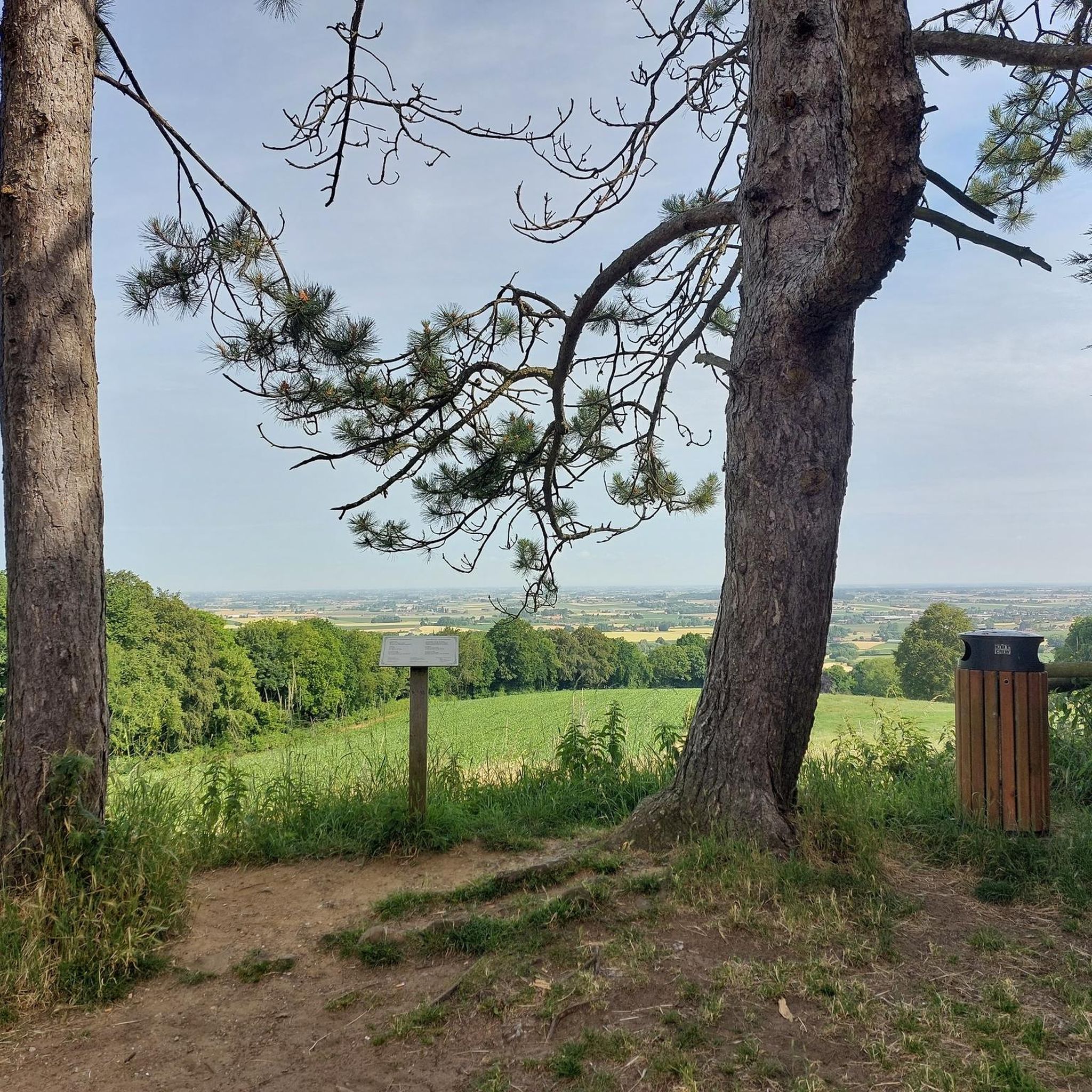
Picnic and rest area with benches, close to the top of the Katsberg with beautiful views over French Flanders.
3
0

Le Moulin de la Roome is a small village. In Dutch 'rooome' means room of cows in the meadow (the mill is located in the middle of a meadow landscape). The restaurant is in fact an old restored farm, next to the mill de la Roome. Rustic interior, simple, but stylish. In the hall of the restaurant is explained how the mill was reconstructed. You can visit the mill on Sunday from 15:30 to 17:30 (€2 for adults, €1.5 for children). Traditional regional dishes.
9
0
This wooden standard mill with an extra long silhouette has been standing along the road to Cassel since 1901. The mill was built in 1774 in Somain. This oil press mill, converted into a grain mill, was active until 1974 and was completely restored. It is on the list of historical monuments.
10
0
Frequently Asked Questions
How many touring cycling routes are available around Saint-Sylvestre-Cappel?
There are over 300 touring cycling routes around Saint-Sylvestre-Cappel, offering a wide range of options for different skill levels and preferences. These routes traverse the undulating terrain of the Monts des Flandres, providing diverse cycling experiences.
What types of terrain can I expect on touring cycling routes in Saint-Sylvestre-Cappel?
The routes in Saint-Sylvestre-Cappel are characterized by the rolling hills of the Flanders Mountains, agricultural fields, and scattered woodlands. You'll encounter a mix of ascents, such as the notable Mont des Récollets, and scenic paths through natural settings, including some gravel sections suitable for adventure cycling.
Are there routes suitable for beginners or families with children?
Yes, Saint-Sylvestre-Cappel offers a variety of routes, including 113 easy and 130 moderate options. While specific 'family-friendly' routes are not detailed, the easier and moderate trails, often through agricultural landscapes, can be suitable for those seeking less challenging rides. Always check the route details for elevation and surface type to ensure it meets your family's needs.
What are some challenging routes for experienced touring cyclists?
For experienced cyclists seeking a challenge, there are 67 difficult routes available. Notable options include the Strade des Cats – Chemin du mont des Cats loop from Eecke, which explores the challenging terrain around Mont des Cats, and the Magnificent view – Katsberg loop from Steenvoorde, which features significant elevation changes.
What can I see along the touring cycling routes in Saint-Sylvestre-Cappel?
The routes offer opportunities to explore various points of interest. You can cycle past the prominent Mont des Cats and its historic Abbey. The charming Cassel Village is also nearby, offering additional exploration. Other landmarks include the Ondankmeulen and various LandArt installations.
What do other touring cyclists enjoy most about cycling in Saint-Sylvestre-Cappel?
The area is highly rated by the komoot community, with an average score of 4.5 stars from over 220 reviews. Reviewers often praise the varied terrain, from rolling hills to agricultural fields and woodlands, and the engaging climbs like Mont des Récollets. The diverse network of paths caters to different ability levels, making it a popular destination for touring cyclists.
Is Saint-Sylvestre-Cappel a good base for exploring the wider French Flanders region by bike?
Absolutely. Saint-Sylvestre-Cappel is ideally situated within the Monts des Flandres, making it an excellent starting point for exploring the surrounding area. Routes often link to nearby towns and features, such as Cassel, allowing for longer touring experiences and a deeper immersion into the region's landscapes and culture.
Are there any specific climbs or challenging sections I should be aware of?
Yes, the Mont des Récollets is a notable climb in the area, measuring 2.1 km with an average gradient of 3.7%. It features a challenging segment with an average gradient of 8.6% towards the end, including a hairpin bend. This Category 5 climb is manageable for cyclists with good fitness and offers a taste of the region's 'mountainous' feel.
What is the best time of year to go touring cycling in Saint-Sylvestre-Cappel?
While specific seasonal data isn't provided, the region's climate in French Flanders generally makes spring through early autumn (April to October) ideal for cycling. During these months, the weather is typically milder and more stable, offering pleasant conditions for exploring the varied landscapes.
Are there any circular touring cycling routes available?
Many of the touring cycling routes around Saint-Sylvestre-Cappel are designed as loops, allowing you to start and finish in the same location. For example, the Sint-Maartenskerk Terdegem – Moulin de la Roome loop from Eecke is a moderate circular route that takes you through scenic areas.
Can I find routes that combine paved roads with gravel sections?
Yes, the region offers routes that cater to both road and gravel cycling. While many touring routes are on paved surfaces, the presence of agricultural and forested areas, as well as mentions of gravel biking opportunities in the region, suggests you can find routes with mixed terrain. Look for routes that traverse through natural settings or specific forest trails.
What is the typical duration for touring cycling routes in this area?
Route durations vary significantly based on distance and difficulty. For instance, the popular Around the Everest of Flanders takes approximately 2 hours 30 minutes, while the more challenging Magnificent view – Katsberg loop from Steenvoorde can take around 3 hours 8 minutes. You can find routes ranging from shorter rides to longer, full-day tours.
Most popular routes around Saint-Sylvestre-Cappel
Most popular attractions around Saint-Sylvestre-Cappel

Get inspired with the komoot mobile app


Explore more
Browse the best Cycling routes in other regions.
