The best road cycling routes around Sceaux-Sur-Huisne
4.6
(33)
1,968
riders
401
rides
Road cycling routes around Sceaux-Sur-Huisne traverse the picturesque Perche Sarthois region and the Huisne valley in France. The area features rolling hills, lush green valleys, and a distinctive bocage landscape of hedged farmlands. Cyclists can expect a network of quiet roads with undulating terrain, offering varied backdrops for rides. The highest point in the commune, the Butte de la Taille, provides panoramic views over the Huisne valley.
Best road cycling routes around Sceaux-Sur-Huisne
- The most popular road cycling route is…
Last updated: May 20, 2026
4.5
(4)
21
riders
74.7km
03:12
470m
470m
Moderate road ride. Good fitness required. Some segments of this route may be unpaved and difficult to ride.
16
riders
40.6km
01:44
340m
340m
Moderate road ride. Good fitness required. Mostly well-paved surfaces and easy to ride.

Sign up for free
7
riders
44.3km
01:51
330m
330m
Moderate road ride. Good fitness required. Mostly well-paved surfaces and easy to ride.
7
riders
54.2km
02:15
310m
310m
Moderate road ride. Good fitness required. Some segments of this route may be unpaved and difficult to ride.
7
riders
27.7km
01:12
180m
180m
Easy road ride. Great for any fitness level. Mostly well-paved surfaces and easy to ride.
Get access to more routes and recommendations from other explorers.
Sign up for free
Already have an account?
Our route recommendations are based on thousands of hikes, rides, and runs completed by other people on komoot.
Start today with a free account
Your next adventure awaits.
Login or Signup



Tips from the Community

Very pleasant for a moment of relaxation
0
0

The first mentions of a place of worship in Tuffé refer to the Sainte-Marie church of the abbey and then the priory, from the 7th century. The creation of the parish of Tuffé is perhaps contemporary or later but currently not documented. Could the priory’s Sainte-Marie church, mentioned much earlier than the Saint-Pierre church, also have once been the parish church of Tuffé? Could the embryo of the current parish church be this private chapel that Hugues Doubleau gave to the abbey with the Sainte-Marie church at the beginning of the 11th century, according to the cartulary of the Saint-Vincent abbey in Le Mans ? In any case, the parish is only attested late by texts (beginning of the 12th century in the same cartulary), but the non-oriented plan of the church, as well as the term Saint-Pierre, argue for the age of the building. The addition of Saint-Paul to the term seems very late, even abusive, since the archival documents systematically refer to a Saint-Pierre church, as does the decoration of the building in the 19th century. If this is an error, it was perhaps induced by Julien-Rémy Pesche at the beginning of the 19th century. The oldest part of the current building is the nave, much remodeled subsequently but the base of the walls of which shows in places a structure made of small rubble stones from the Romanesque period at the latest. But above all, the north gable wall and the first bay of the gutter walls show traces of openings and corner chains made of bricks alternating with limestone cut stones. This formula, rare if not unique in Perche Sarthois, is debated as to its dating. Some historians see it as a testimony to Carolingian architecture. Others, more cautious, put forward an archaic dating of the 11th century, where the use of brick alternating with stone would be an economic choice rather than an aesthetic one: this would explain a certain irregularity in the implementation, particularly in the arch of the old door of the north gable wall. The same uncertainty hangs over the addition of the buttresses and the opening of the current north gate. The nave is covered with a new framework and a spire and the paneling was installed in 1604 as evidenced by the signature (repainted in 1885) “In 1604 this Church was labruchée – Tomas Mabile attorney of the Fabrique de Séans ". The dating of the other parts of the church is not much easier. The construction of the east chapel (presbytery side) is not in too much doubt, the Renaissance decoration of the door to the street and the cupboard, although crude, indicates the middle of the 16th century. This chapel, dedicated to the Virgin, belonged to the lords of Chéronne. Its western counterpart (square side), dedicated to the Sacré-Cœur and built by the lords of Ramée, is less easy to date due to lack of ancient decor. This chapel could have been built shortly before or shortly after that of Chéronne, but undoubtedly not simultaneously, as evidenced by the slight asymmetry of the roofs and the different profile of the structural members. The apse, generally considered to also date from the 16th century, could only be from the 3rd quarter of the 18th century, as a bundle of clues suggests: the axial wall left blind probably to accommodate an altarpiece, the plan burrow made between 1757 and 1759 which still shows a circular apse undoubtedly Romanesque, as well as a document from 1775, indicating that the priest "would have had the necessary and pleasant works done to the great altar of the said church caused by the demolition and construction that Mrs de Saint-Vincent would have had the gable of the said church made. The sacristy would be a 17th century addition.
0
0
In this architecture we find different styles and periods, from the 12th, 15th, 16th to the 19th century, including Gothic and Neo-Romanesque. Romanesque bays and foothills. Stained glass window and 16th century font as well as the current apse and the two side chapels. The south door with its lintel and its straight feet decorated with rosettes and diamonds. The church had stained glass windows from the end of the 15th and beginning of the 16th century. Fragments exist in the speckles and spandrels of the bay of the Rosary Chapel, listed in 1983. The stained glass windows are almost all dated and signed by the same glass painter between 1885-1889 "af Paris" probably Anselme Fialex, son of François Fialex who was a glass painter in Mayet Creation of an entrance to the square as well as the opening of new 19th century bays. the vault, paneled and undoubtedly painted from the beginning, was redone in 1602 with restoration in the 19th century, when a new decoration was painted. The main altar dates from 1867.
0
0
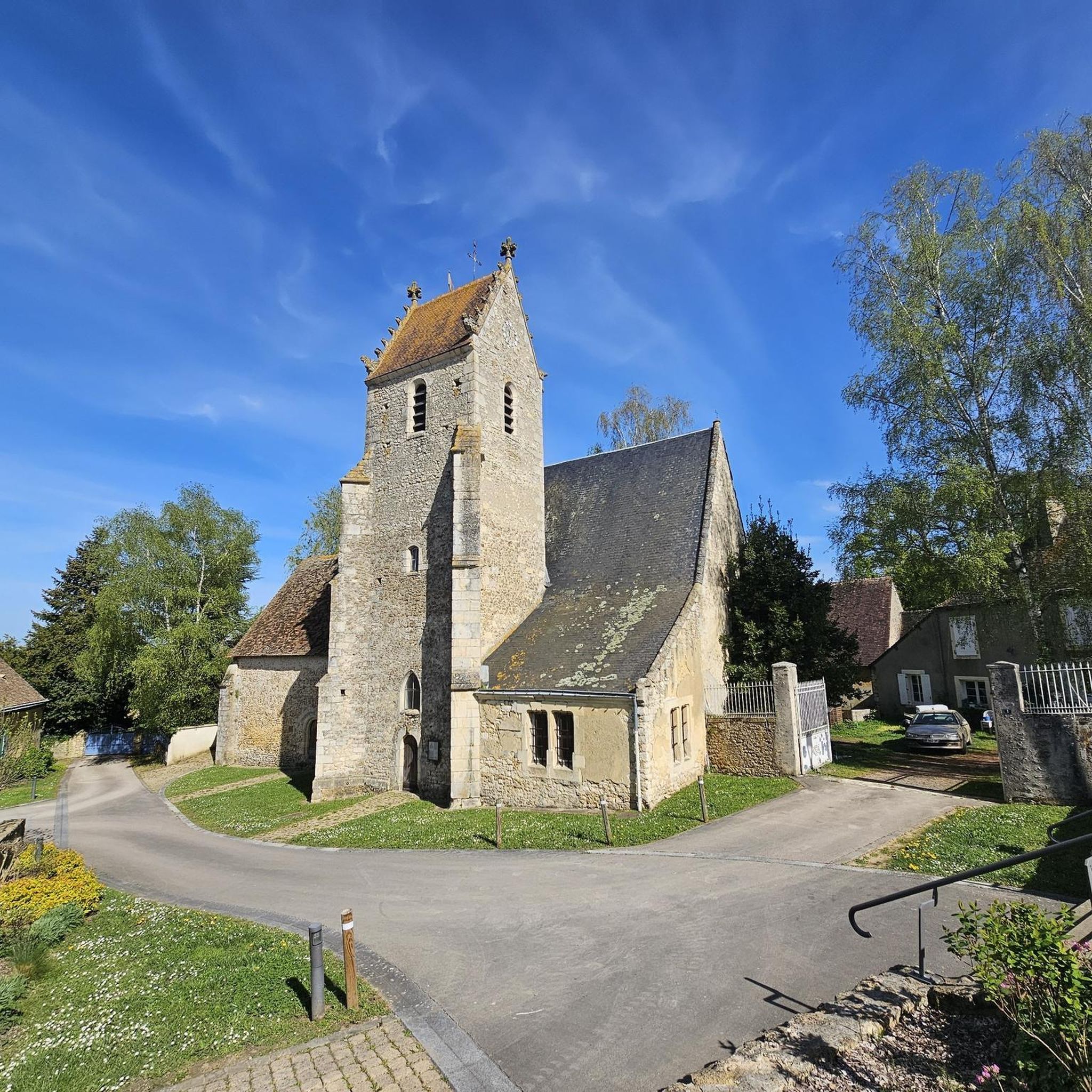
The first mentions of the Saint-Germain church in Sceaux-sur-Huisne appear in the cartulary of the Saint-Vincent abbey in Le Mans: around 1050, Bouchard de Théligny gave the Sceaux church land and a meadow located at proximity. At this time, the building, then "in bad woods", was rebuilt in stone. The nave is considered to be the oldest part of the church and dates back to the 11th century, but it is in reality difficult to date due to multiple alterations and even reconstructions. The masonry shows several repetitions and a confused assembly of elements which could come from older buildings, such as the remains of the Gallo-Roman villa which was exhumed at the end of the 19th century in the valley (small regularly cut rubble stones, debris of roof tiles). There are also traces of old openings, such as a door opening onto the priory. Although it is probable, there is no element to formally identify the Romanesque construction. The current openings are later, such as the small Gothic bay in the western wall and perhaps the south door (15th century?) and the other openings probably made around the first half of the 18th century. Significant masonry and structural work is actually mentioned in the nave in 1709. The choir and the bell tower were probably built in the first half of the 16th century, in a late Gothic style. The factory accounts mention various works in the 1530s and 1540s: roofing, construction of a ballet, stained glass window of the "grant window"... The tower was perhaps built in several stages if we rely on the changes masonry nets in the elevation. It was visibly remodeled at the end of the 16th century or the beginning of the 17th century, as indicated by the semi-circular openings, one of which was walled up. From 1570, the du Bouchets were lords of Sceaux and had their coat of arms, "azure with three rings of sand", affixed to the keystone of the chapel under the bell tower (since replaced by a flower) and on the vault paneled nave and choir. As for the windows on the north wall of the choir, they were undoubtedly open in the 18th century like those in the nave. During the Revolution, the church was seized as national property and sold to a certain René Neveu in September 1796, excluding the furniture. The two bells installed in 1719 and the fittings were handed over to the administration to be melted down. The church was returned to the town after the death of Mr. Neveu in the 1810s. The church underwent some occasional maintenance work (mainly on the roof) in the 19th and 20th centuries, but not an overall restoration. In 1831, an estimate was drawn up to enlarge the church with a chapel, in order to better accommodate all parishioners: this project was not carried out. The same year, the flag which still covers the bell tower was put up. The current sacristy (Gambert architect) was added in 1862 to replace another very dilapidated one, blocking a window now only visible from the inside. The second half of the 19th century also saw the clearing of the surroundings of the church, cluttered with lean-tos and hidden by an imposing washhouse finally moved in 1870. The last work, concerning the roofing, was carried out in 1989. The church of Sceaux-sur-Huisne has been listed as a Historic Monument since 1926.
0
0

The Palets de Gargantua is a megalithic structure that was originally a dolmen. Looking at it in its environment, one can't help but wonder which came first: the rock...or the tree...? The tree trunk giving way to the rock of course gives the answer to this question.
2
0
A place conducive to hiking and a pleasant setting. A beach at one end of the lake allows you to rest.
2
0

This door probably existed from the origin of the fortification of the city. The current building was however rebuilt, at the same time as the enclosure, around 1480. It has a function that is both ostentatious and legal. It actually served as a place of collection of the granting (tax on goods) under the Old Regime. Its monumentality and its decor express the importance given to the city at the time.
0
0

nice view with a large park, ideal for a break
0
0
Frequently Asked Questions
How many road cycling routes are available around Sceaux-Sur-Huisne?
There are over 400 road cycling routes available around Sceaux-Sur-Huisne on komoot. This extensive network caters to various preferences, with approximately 90 easy routes, nearly 300 moderate routes, and 15 more challenging options for experienced cyclists.
What kind of terrain can I expect when road cycling in the Sceaux-Sur-Huisne area?
The Sceaux-Sur-Huisne area, nestled in the Perche Sarthois region and Huisne valley, is characterized by its undulating terrain. You'll find rolling hills, lush green valleys, and a distinctive 'bocage' landscape of hedged farmlands. The routes offer magnificent views without ascending long passes, making them enjoyable for various fitness levels.
Are there any family-friendly road cycling routes in Sceaux-Sur-Huisne?
Yes, the region offers several family-friendly options, particularly among the 90 easy routes available. A good example is the Porte Saint Julien – Lake loop from Sceaux - Boëssé, which is an easy 28.4 km trail leading through the Huisne valley and past a lake, often completed in about 1 hour 10 minutes.
What are some notable landmarks or attractions I can see along road cycling routes?
Many routes pass by historical and natural points of interest. You might encounter the historic Porte Saint Julien, the 11th-century Saint-Germain Church of Sceaux-sur-Huisne, or the picturesque lavoir and Romanesque bridge within the village. The Tuffé Val de la Chéronne Leisure Centre and La Chéronne Castle are also nearby attractions that can be incorporated into your rides.
What do other road cyclists enjoy most about road cycling in Sceaux-Sur-Huisne?
The road cycling routes in Sceaux-Sur-Huisne are highly rated by the komoot community, with an average score of 4.6 stars from over 30 reviews. Cyclists often praise the network of quiet, scenic roads, the varied undulating terrain that offers engaging rides without extreme climbs, and the beautiful, historically rich setting within the Perche Sarthois and Huisne valley.
Are there any long-distance or challenging road cycling routes for experienced riders?
Yes, for experienced riders seeking a challenge, there are 15 difficult routes available. Additionally, many moderate routes offer significant distances and elevation. For instance, the Gargantua's Palet – Champagné Mill loop from Sceaux - Boëssé is a moderate 79.7 km trail with over 500 meters of elevation gain, providing a substantial ride.
Can I find circular road cycling routes around Sceaux-Sur-Huisne?
Yes, many of the road cycling routes in the Sceaux-Sur-Huisne area are designed as loops, allowing you to start and finish in the same location. Examples include the Porte Saint Julien loop from Sceaux - Boëssé (40.6 km) and the Roadbike loop from Sceaux - Boëssé (44.3 km), both offering scenic circular journeys.
What is the best time of year for road cycling in Sceaux-Sur-Huisne?
The region is generally pleasant for cycling from spring through autumn. The 'Routes tranquilles du Perche' network, for example, is ideal for immersing yourself in the natural park's beauty during these seasons. Spring brings blooming landscapes, while autumn offers vibrant colors, both with generally mild weather conditions suitable for road biking.
Is Sceaux-Sur-Huisne connected to any larger cycling networks?
Yes, the region is part of broader cycling initiatives. The well-known 'La Vélobuissonnière' cycle route, which extends for 250 km, utilizes approximately 85% small, low-traffic roads and connects Alençon and Saumur via Le Mans and the Sarthe valley. This route integrates with other major cycling routes like the Véloscénie and Loire à vélo, offering opportunities for extended tours.
Are there any routes that offer panoramic viewpoints?
Absolutely. The 'Butte de la Taille,' which is the highest point in the commune of Sceaux-Sur-Huisne, offers panoramic views over the Huisne valley. Many routes are designed to showcase the region's 'magnificent views,' particularly those traversing the rolling hills of the Perche Sarthois.
Where can I find more information about the local heritage discovery tours by bike?
The Pays du Perche Sarthois features '10 heritage discovery tours' by bike, designed to showcase the region's rich architecture and landscapes. One notable route, 'Héritage de la Vallée de l'Huisne,' provides detailed insights into points of interest. You can find more details on these specific tours through local tourism resources, such as the La Ferté-Bernard tourism office, which provides a detailed PDF guide: Sceaux-sur-Huisne Heritage Guide.
What is the typical elevation gain on road cycling routes in this area?
The terrain is described as undulating, offering varied elevation gains suitable for different levels. For example, a moderate route like the Champagné Mill – Rillette from Parigné-l'Évêque loop from Sceaux - Boëssé, which is 78 km long, features around 400 meters of elevation gain. Even longer routes, such as the 79.7 km Gargantua's Palet – Champagné Mill loop from Sceaux - Boëssé, have approximately 500 meters of ascent, providing engaging climbs without extreme mountain passes.
Most popular routes around Sceaux-Sur-Huisne
Most popular attractions around Sceaux-Sur-Huisne

Get inspired with the komoot mobile app


Explore more
Browse the best Road cycling routes in other regions.
