The best road cycling routes around Roye
4.4
(5)
176
riders
32
rides
Road cycling routes around Roye are situated in the Somme department of the Hauts-de-France region, characterized by the generally flat Santerre plains. The area is traversed by the Avre River and features accessible natural elements such as nearby woodlands and forests. While predominantly flat, routes around Roye offer varied topography with gentle elevation gains, providing diverse cycling experiences.
Best road cycling routes around Roye
- The most popular road cycling route is Roadbike loop from Roye, a 29.2 miles (47.1…
Last updated: May 21, 2026
5
riders
47.1km
01:55
180m
180m
Easy road ride. Great for any fitness level. Mostly well-paved surfaces and easy to ride.
4
riders
51.6km
02:06
250m
250m
Moderate road ride. Good fitness required. Mostly well-paved surfaces and easy to ride.

Sign up for free
5
riders
76.1km
03:06
330m
330m
Moderate road ride. Good fitness required. Some segments of this route may be unpaved and difficult to ride.
3
riders
42.1km
01:45
120m
120m
Easy road ride. Great for any fitness level. Mostly well-paved surfaces and easy to ride.
3
riders
51.0km
02:05
250m
250m
Moderate road ride. Good fitness required. Mostly well-paved surfaces and easy to ride.
Get access to more routes and recommendations from other explorers.
Sign up for free
Already have an account?
Our route recommendations are based on thousands of hikes, rides, and runs completed by other people on komoot.
Start today with a free account
Your next adventure awaits.
Login or Signup
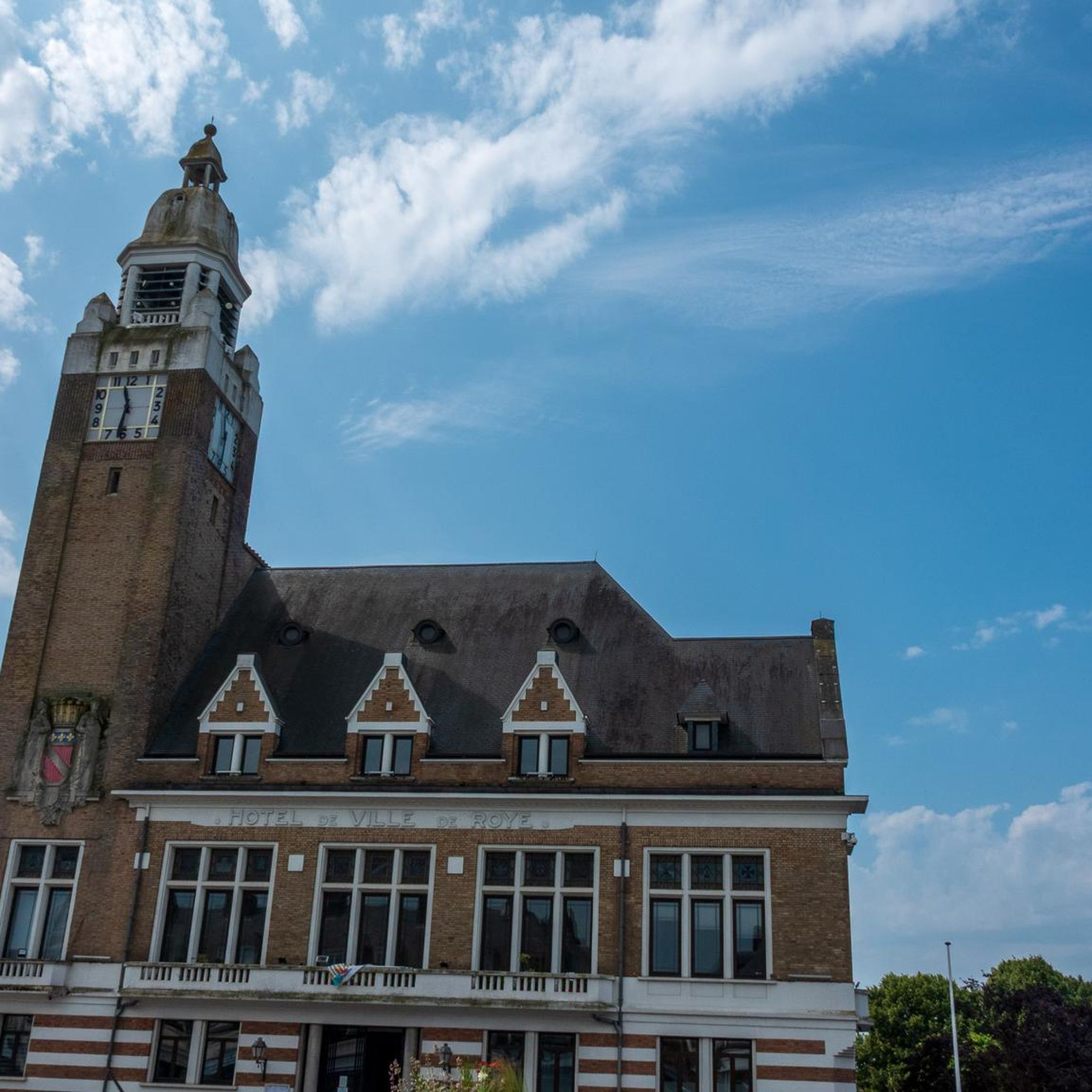



Tips from the Community

The reconstruction of Notre-Dame, consecrated in 1928, was designed by Swiss architect Albert Montant—who also designed the church of Canny-sur-Matz. Albert Montant was an excellent connoisseur of medieval architecture, and the building, constructed of brick with some stone elements, contains numerous references to Romanesque architecture, revisited here with great originality and sensitivity. The plan features a bell tower porch, a single nave, and a choir with side aisles, culminating in an apse framed by two apsidioles. Each section has its own distinctive features. The bell tower porch—which echoes that of the previous church—opens with a semicircular arched portal with three arches resting, on each side, on as many small columns via cubic capitals. Three small, offset windows open above, and a gable crowns the whole. Instead of the traditional gallery, the bell tower porch forms, inside, a richly lit lantern crowned by a four-sided dominion vault. Of Carolingian origin, the lantern tower enjoyed great popularity in Anglo-Norman architecture and beyond, as evidenced by the one at Laon Cathedral. The nave has three bays with semicircular barrel vaults. Its two transverse arches are supported by abacuses surmounting consoles, a device intended to house statues, now missing. The choir is covered with a barrel vault that closes in a cul-de-four at the apse. Eleven small semicircular windows penetrate this vault, the base of which is highlighted by a continuous cordon of billets. Three semicircular arches resting on circular piers provide access to the side aisles, each covered with a semicircular barrel vault. This entire ensemble clearly draws its inspiration from the Romanesque architecture of Berry and Auvergne. In the nave, we notice six stained-glass windows by Blanchet-Lesage (1959) on the themes of Faith, Charity, Hope, Prudence, Justice, and Strength (2008).
0
0


This cemetery was created in 1920 by the French State, which brought together in one place the graves of 49 military cemeteries or military squares of communal cemeteries. It houses 6,545 remains of soldiers including 3,755 in individual graves, 126 of which are unidentified and 2,790 in two ossuaries, 116 of which are unidentified. The tombs are materialized by stone crosses. More than 2,000 soldiers killed from the winter of 1914 to the summer of 1916 lie in this cemetery. However, the vast majority of the graves are those of soldiers who fell during the Battle of the Kaiser in the spring of 1918 and the Hundred Days Offensive led by the Allies from the summer of 1918. Against the east wall of the cemetery, near the entrance, a commemorative plaque pays homage to Richard von Heydebreck who died on June 12, 1918. A monument erected inside the necropolis pays homage to the German and French soldiers who fell near Liancourt - Pit in 1915, about ten kilometers away. Wikipedia
1
0

More exactly the only remaining tower of the castle.
0
0
Frequently Asked Questions
How many road cycling routes are available around Roye?
There are nearly 30 road cycling routes available around Roye, catering to various skill levels. You'll find options ranging from easy to moderate, with a few more challenging routes for experienced cyclists.
What is the typical terrain like for road cycling near Roye?
The terrain around Roye is primarily characterized by the generally flat Santerre plains, but it also offers varied topography with gentle elevation gains. You can expect a mix of open agricultural landscapes, sections along the Avre River, and rides through nearby woodlands.
Are there any easy road cycling routes suitable for beginners in Roye?
Yes, Roye offers several easy road cycling routes perfect for beginners or those seeking a relaxed ride. For example, the Roadbike loop from Roye is an easy 47.1 km trail with a manageable elevation gain of 181 meters.
Can I find more challenging road cycling routes with significant elevation around Roye?
While the region is generally known for its gentle terrain, you can find routes with more significant elevation gains. The Tour Roland loop from Roye, for instance, is a moderate 51.6 km path with an elevation gain of 250 meters, offering a bit more challenge beyond the flat plains.
What natural features can I expect to see while cycling around Roye?
Road cycling routes around Roye often feature the Avre River, which crosses the town, and lead through accessible natural elements such as nearby woodlands. You might also encounter local green spaces like the 'Coulée Verte' or the recreational area 'Demouy'. Further afield, the Somme department is known for the Baie de Somme, a beautiful natural bay.
Are there historical landmarks or attractions along the road cycling routes in Roye?
Yes, you can incorporate historical landmarks into your rides. Roye itself boasts the 15th-century Saint-Gilles Church and the Saint-Laurent Tower, a remnant of ancient fortifications. Routes like the Tower of the Château de Ham – Ham Town Hall loop from Roye can take you past significant historical sites in the wider region. You can also explore highlights such as the Château de Boulogne-la-Grasse or the Church of the Assumption of Our Lady.
Are there any circular road cycling routes available from Roye?
Yes, many of the road cycling routes around Roye are designed as loops, allowing you to start and end in the same location. Examples include the popular Roadbike loop from Roye and the scenic Road Through the Woods loop from Roye.
What is the best time of year for road cycling in the Roye region?
The region is generally pleasant for road cycling from spring through autumn. Spring brings wildflowers like wood anemones and wild hyacinths to local woodlands, while summer offers longer daylight hours. Always check the local weather forecast before heading out.
Is it possible to find family-friendly road cycling options around Roye?
For family-friendly cycling, consider the easier routes with less elevation. The 'Coulée Verte' within Roye, a 1.5 km path on an old railway line, is particularly suitable for small bikes and provides a safe, flat environment with play areas. Many of the easy road cycling loops can also be adapted for families.
Where can I find parking for my car when starting a road cycling route in Roye?
Roye, as a town, typically offers various public parking options. It's advisable to check local signage for specific parking regulations and availability near the starting points of your chosen routes. Many routes originate directly from the town center, making it convenient to park there.
Are there cafes or places to stop for refreshments along the routes?
As you cycle through Roye and its surrounding villages, you'll find opportunities to stop for refreshments. Roye itself has various amenities, and smaller towns along the routes may offer local cafes or bakeries. Planning your route in advance can help identify suitable stopping points.
What do other cyclists say about road cycling in Roye?
The road cycling routes in Roye are highly rated by the komoot community, with an average score of 4.0 stars. Cyclists often praise the varied terrain that goes beyond just flat plains, the accessibility of natural features, and the well-maintained paths that offer diverse cycling experiences.
Are there any long-distance road cycling options near Roye?
While many routes are designed as loops around Roye, the broader Somme department is recognized for its cycling infrastructure, including the Somme Valley Cycle Route (Véloroute de la Somme). This offers opportunities for longer rides and connecting to diverse landscapes beyond the immediate Roye area.
Most popular attractions around Roye

Get inspired with the komoot mobile app


Explore more
Browse the best Road cycling routes in other regions.
