Attractions and Places To See around Sauzet - Top 20
Attractions and places to see around Sauzet include a rich tapestry of historical landmarks and natural beauty. This charming medieval village, located on a limestone hill in the Drôme Provençale region, is recognized for its preserved heritage. Visitors can explore a fortified village with narrow, cobbled streets and enjoy panoramic views of the Valdaine plain and distant mountains. The area offers a blend of cultural sites and opportunities for outdoor activities.
Best attractions and places to see around Sauzet
- The most popular attractions is Montcuq Old Town, a historical site that features an old town center dominated by a large 12th-century keep. Small streets and old stone houses characterize this place, inviting visitors to linger.
- Another must-see spot is Albas, a settlement known for its medieval castle, the Chateau d'Albas, built in the 13th century. This cozy town also offers a pleasant atmosphere with a café under plane trees.
- Visitors also love Saint-Hilaire Church of Montcuq, a religious building with an octagonal tower that, along with the 30-meter-high keep, forms the silhouette of Montcuq. The surrounding village offers a charming tree-lined promenade for relaxation.
- Sauzet is known for its historical sites, medieval architecture, and natural viewpoints. The region offers a variety of attractions, from fortified villages and ancient churches to scenic landscapes and local markets.
- The attractions around Sauzet are appreciated by the komoot community, with more than 50 upvotes and over 30 photos shared by visitors.
Last updated: June 24, 2026
Montcuq Old Town
Highlight • Historical Site
Translated by Google •
Tip by

Albas
Highlight • Settlement
Translated by Google •
Tip by

Sign up now to discover places like this
Get recommendations on the best single tracks, peaks, & plenty of other exciting outdoor places.
Sign up for free
Saint-Hilaire Church of Montcuq
Highlight • Religious Site
In July 2022, the village was chosen over the city of Lyon to host the first Popcorn Festival. "Popcorn" is a show broadcast every Tuesday on Twitch. It is hosted by Domingo with hand-picked guests. It discusses current events, but not only that. For over two and a half hours, the viewer has no time to get bored. The event is now one of the most watched on the streaming platform.
Montcuq is a charming village. Its tree-lined promenade runs along the lower part of the village, offering a lovely stroll as well as a perfect place to relax.
Translated by Google •
Tip by

Albas suspension bridge
Highlight • Other
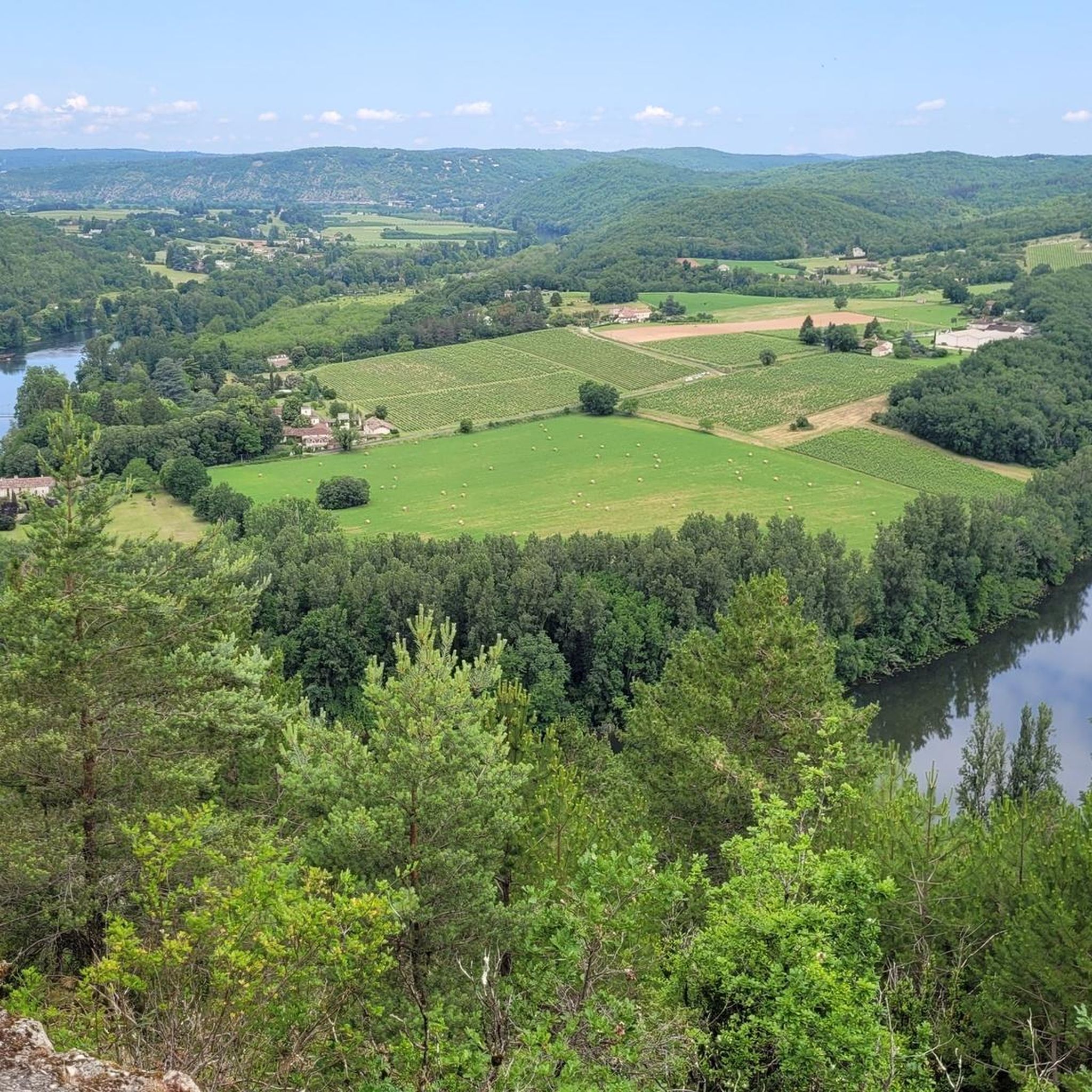
Albas la Jolie, mostly built on a cliff above the Lot, one of the most beautiful “spots” in the Lot valley.
Albas was once a port from which the great wines of Cahors left to reach the city of Bordeaux by barge.
The famous Cahors vineyard is just across the suspension bridge.
Started in December 1932, it was in November 1933 that this work was inaugurated.
Thus, the dream of an entire locality, cherished for fifty years, thus became reality.
It was finally possible to cross the Lot, at any time and in safety, something unthinkable decades before.
The mayor at the time, Mr. Dulac, could present to his constituents an achievement that satisfied the entire population.
It must be recognized that the technical means of the time were far from those we know today
The newspapers on this occasion spoke of “an elegant bridge and a manifestly proven solidity.
the footbridge will forever remain the link between the two banks of the Lot.
Translated by Google •
Tip by

Luzech
Highlight • Historical Site
On the plateau, we distinguish the oppidum of the Impernal, whose ruins are two thousand years old.
Translated by Google •
Tip by

Sign up for free to discover even more attractions around Sauzet.
Sign up for free
Already have an account?
Start today with a free account
Your next adventure awaits.
Login or Signup


Tips from the Community


Nice view of the center from the narrow bridge
0
0

very nice view Albas suspension bridge
0
0
Albas is a small town located in the department of Lot-et-Garonne, in the south-west of France. It is located on the banks of the Lot River, about 30 kilometers east of Agen. The town is known for its medieval castle, the Chateau d'Albas, which was built in the 13th century. The castle has been restored and can be visited today. Albas is also known for its caves, the Grottes de Lastournelle, which offer guided tours to discover their unique geological formations. Besides its historical and natural heritage, Albas also offers many outdoor activities for visitors, including hiking trails, cycle paths and water activities on the Lot. The town is also known for its local gastronomy, with fresh, quality produce from surrounding farms. Albas is a charming little town, offering many activities for visitors, as well as a rich history and culture. Whether it is to discover its historical and natural heritage, enjoy outdoor activities or taste the local specialties, Albas is really worth the detour.
0
0

In the heart of the Cahors vineyard, this small town clings to both sides of a rocky isthmus. On the plateau, we distinguish the oppidum of the Impernal, whose ruins are two thousand years old.
1
1

in Montcuq observe the sculptures of the St-Hilaire church, built around 1250/1270 in La COUnco (Conca in written oc, the SHELL) OUTSIDE the first ramparts (it replaced a primitive St-Sernin, located at the foot of the tower , Place del Plàn, west, therefore prior to Charlemagne) The church, said OUTSIDE the WALLS again in 1350, is marked by interior sculptures (transept, choir, apse) of the most esoteric...their hidden meanings are foreign to Christianity. ..Other old medieval houses are also rich in sculptures with secret meanings: house with the sign "Four 4", shortly after the town hall going up towards St-Hilaire, on the right, 13th century house at the bottom and on the right from the rue du Plàn, Very old names have been preserved: Pàtus (= small square) del Potz/Pouttss, Carriéro (= Rue) de l'Aste (de la Lance en oc: Asto), Carriéro Dréytsho (rue Droite) d 'others, known: quarry of the Fourns, fourn nàut é fourn batch, quarry of the Gatsharîo, quarry of the Ribiéyro de Mouncuc, Fîu Soubiràn (Sovereign Fief "or--Sup Latin eranus--- "from the top of the town"), Cantou de Quantard, Cantou de VillaBorgonh--Billobourgounn--, Plàça de la Caminada (from the Old Presbytery after 1450, below the Parish House): under the Mediatheque , Prat del Gassàyrou, Bàrri (district) of Valeta, de Rozet, Camy de Pènn..etc..), have not had the happiness of being formalized, replaced by falsely "occitanizing" names! of Montcuq of the "vanellas (banéllos), empty spaces separate the houses and wide of 75cms, two and a half feet, a distance dating from the Roman Empire! Montcuq was legendaryly founded in the year of the Millennium of Rome, a combe bears the name de Vielha Roma" (Byélyo Roumo) OLD ROME,..the house at the bottom of the Rue du Plàn seems to have been a Jewish house, even of a rabbi and descendant of the tribe of Judah...In the Tower the points of the horizon indicated by the median axes of the openings, windows and door, correspond to places loaded with myths and related to sunrises and sunsets s solar, lunar, stars, constellations, on key dates of the year and therefore of the Old Calendar of the "Old Religion", as said of the secret and mysterious depths of old Quercy, the real one, not the one Tourists, such as "More-Than-Healer" of the Pays de Montcuq..
2
0
The problem is that Montcuq is a village in the OC region and that the pronunciation of the name follows the rules of OCCITAN, and southern French, region (33 departments in the south of France...) and languages ( Occitan and southern French) where ALL the LETTERS are PRONOUNCED!!....in all the Oc countries and in Quercy in particular (White or other!) we therefore pronounce "Monkükkk" by stating very clearly the last consonant.. .and if you want to be, or pass for being, from the country you will even pronounce "Mounnkükk" or even MounKütt"..as for the inhabitants, they are not the Montcuquois but the Mountcuquiols..and Quercy is pronounced Càrci (tonic accent on Cà ,Rroulé) and Quercy Blanc is called, in Oc, Càrci Albènc (albènnkk)...As for Barguelonne, we do not know it under the name of Barguelonnette...but, in Oc, of bargoLOUno...The name de Quercy-Blanc is very recent, it has no historical roots...it is a creation of geographers...the only old name is "Pàis dels Valls" (Country dellss Ballss: Spanish style)Country Valleys...(direct tributaries of the Middle Garonne) in a North-East to South-West direction... The causses are invaded by spontaneous Mediterranean vegetation, wild fig trees, pistachio trees, terebinths, asphodels, wild asparagus, Montpelleier maples, Phillyres (sub-Saharan shrubs!) attest that ..the environment lends itself to it...the great master of the sky in these regions is the Autan Wind..coming from the Balearic Islands...and the culture is all Occitan...
2
0
Frequently Asked Questions
What historical and cultural sites can I explore in Sauzet?
Sauzet is rich in history, recognized as a 'Petites Cités de Caractère'. You can wander through the fortified medieval village with its narrow, cobbled streets and vaulted passages, discovering remarkably preserved stone houses and 11th-century fortifications. Don't miss the historic Courtine square, the 12th-century Saint-Lambert Church, and the Romanesque Chapelle des Pénitents, which offers exceptional panoramic views. For an interactive experience, follow the historical trail or try the Baludik digital walk.
Where can I find the best panoramic views around Sauzet?
From the village of Sauzet itself, particularly from the esplanade near the Saint-Lambert Church and the Chapelle des Pénitents, you can enjoy superb panoramic views. These vistas stretch across the fertile Valdaine plain, the Drômoise hills, and in the distance, you can spot the Préalpes Drômoises and the Monts d'Ardèche.
Are there any family-friendly activities or attractions in Sauzet?
Exploring the medieval village of Sauzet is a great family activity, with its labyrinth of alleyways and historical markers like gargoyles and machicolations. The Baludik digital walk offers an engaging and interactive way for families to discover the village's past. Additionally, the nearby outdoor trails provide opportunities for walks suitable for various ages.
What outdoor activities can I do near Sauzet?
The area around Sauzet is ideal for outdoor enthusiasts. You can find various hiking and cycling routes, such as the 'Sentier des Grands Abris' and the 'Boucles de la Valdaine', which offer scenic excursions through heritage sites and lavender fields. For more specific routes, explore the hiking trails around Sauzet, MTB trails, or running trails.
What are some notable nearby villages or towns to visit from Sauzet?
Sauzet is conveniently located near several picturesque villages. You can visit Le Poët-Laval, known for its pedestrianized cobbled streets, or explore Mirmande, Rochemaure, Saint Vincent de Barrès, and Alba-la-Romaine. Just 7 km away is Montélimar, famous as the capital of nougat. Don't miss Albas, a cozy town with a medieval castle, or Luzech, nestled in the heart of the Cahors vineyard.
Are there any unique local events or markets in the Sauzet area?
Yes, if you visit at the end of July, you might experience the festive and gourmet Foire à l'Ail (Garlic Fair), which celebrates garlic with the 'Confrérie des Chevaliers de l'Ail de la Drôme'. Additionally, numerous local markets in nearby towns, such as Montelimar, La Begude-de-Mazenc, Le Teil, and Loriol-sur-Drome, offer a chance to experience regional life and local produce throughout the week.
What is the best time of year to visit Sauzet attractions?
The Drôme Provençale region, where Sauzet is located, is generally pleasant from spring to autumn. Spring offers blooming landscapes, while summer is vibrant with local events like the Garlic Fair. Autumn provides milder weather and beautiful colors. For outdoor activities, spring and autumn are ideal, while summer is perfect for enjoying the village's charm and nearby markets.
Can I find cafes or pubs near the attractions in Sauzet?
Within Sauzet's medieval village, you'll find local establishments to relax and enjoy the atmosphere. For a wider selection, nearby towns like Montélimar offer various cafes and pubs. The town of Albas, for instance, has a cozy café on its square under plane trees, perfect for a break.
What are some of the most popular attractions around Sauzet, according to visitors?
Visitors particularly enjoy the historical charm of the region. Highlights include Montcuq Old Town, known for its 12th-century keep and charming streets, and Albas, a settlement with a medieval castle and a pleasant atmosphere. The Saint-Hilaire Church of Montcuq, with its octagonal tower, is also a popular spot, offering a lovely tree-lined promenade nearby.
Are there any unique architectural sights in Sauzet?
Beyond the medieval fortifications and the Saint-Lambert Church, Sauzet also features the Villa Sestier, an interesting example of Art Nouveau architecture. As you explore the village, keep an eye out for unique details like gargoyles, machicolations, and mullioned bays that reflect centuries of architectural history.
What kind of hiking trails are available near Sauzet?
The area offers a variety of hiking trails suitable for different skill levels. You can find easy loops like the Albas and Croix de Girard Loop, or more challenging routes such as the Albas – Waterfront trail loop. Many trails, including the 'Sentier des Grands Abris', allow you to explore the natural beauty and heritage sites of the Drôme Provençale.

Get inspired with the komoot mobile app


Explore more
Still not found the Highlight you’re looking for? See guides of the top attractions in other regions:
