Attractions and Places To See around Montigny-Montfort - Top 20
Best attractions and places to see around Montigny-Montfort, a commune in the Côte-d'Or department of France, offers a blend of historical landmarks, natural beauty, and cultural sites. The area is characterized by its historical significance, including ancient castles and abbeys, alongside scenic waterways and natural curiosities. It serves as a gateway to exploring the rich heritage and diverse landscapes of Burgundy.
Best attractions and places to see around Montigny-Montfort
- The most popular attractions is Fontenay Abbey, a religious building…
Last updated: July 6, 2026
Buffon's Big Forge
Highlight • Historical Site
Translated by Google •
Tip by

MuséoParc Alésia
Highlight • Historical Site
Don't forget to go to the archeological Alesia site where you can see ruins of the real …
Tip by

Sign up now to discover places like this
Get recommendations on the best single tracks, peaks, & plenty of other exciting outdoor places.
Sign up for free
Montbard
Highlight • Settlement
Translated by Google •
Tip by

Canal de Bourgogne and Its Locks
Highlight • Structure
It crosses picturesque landscapes of Burgundy.
It is also a crossing of the history of this region with these monuments which …
Translated by Google •
Tip by

Fontenay Abbey
Highlight • Religious Site
Translated by Google •
Tip by

Sign up for free to discover even more attractions around Montigny-Montfort.
Sign up for free
Already have an account?
Start today with a free account
Your next adventure awaits.
Login or Signup
Tips from the Community

I highly recommend visiting the abbey church of St Thibault in St Thibault! A pure marvel!
0
0

The Abbey of Fontenay, like all monasteries and places of worship, was, of course, founded or built first and foremost as a place of prayer. Due to its outstanding significance, it has also been honored with the title of "World Heritage Site" by UNESCO. The German-language television series "Treasures of the World – Heritage of Humanity" documents these special sites around the world in quarter-hour segments. One episode also deals with this abbey, and the website reads: * "France at the end of the 11th century. Christianity has prevailed. The noble abbots of the Benedictine monasteries live in prosperity. The monastic ideal of poverty and modesty seems to have been forgotten. A new order is founded in Burgundy. It calls its followers to return to early Christian ideals: to work and poverty, to humility and seclusion from the world. The monks establish their first monastery, "Citeaux," after which they later call themselves Cistercians. The order grows rapidly. The monks clear the forests and regulate the rivers. Their religious houses soon spread throughout France, even to Germany. The Fontenay Abbey is also founded under them." The film is available in the ARD media library at the following link =>> https://www.ardmediathek.de/video/schaetze-der-welt/fontenay-frankreich-folge-11/swr/Y3JpZDovL3N3ci5kZS83MjQ3MjIw
3
1
The Abbey of Fontenay was, like all monasteries and places of worship, of course founded or built first and foremost as a place of prayer. Due to its outstanding importance, it has also been "ennobled" by UNESCO with the title of "World Cultural Heritage". The German-language television series "Treasures of the World - Heritage of Humanity" documents these special sites all over the world in quarter-hour contributions. One episode also deals with this abbey, on the website you can read: * "France at the end of the 11th century. Christianity has prevailed. The noble abbots of the Benedictine monasteries live in prosperity. The monks' ideal of poverty and modesty seems to have been forgotten. A new order is founded in Burgundy. It calls on its followers to return to original Christian ideals: to work and poverty, to humility and seclusion from the world. The monks found their first monastery "Citeaux", after which they later call themselves Cistercians. The religious order grows quickly. The monks clear the forests and regulate the rivers. Their religious houses soon spread across France and into Germany. The Fontenay monastery was founded under them." The film is available in the ARD media library at the following link: => https://www.ardmediathek.de/video/schaetze-der-welt/fontenay-frankreich-folge-11/swr/Y3JpZDovL3N3ci5kZS83MjQ3MjIw
5
0

The world heritage monastery is worth a visit. However, there is an entrance fee.
3
0

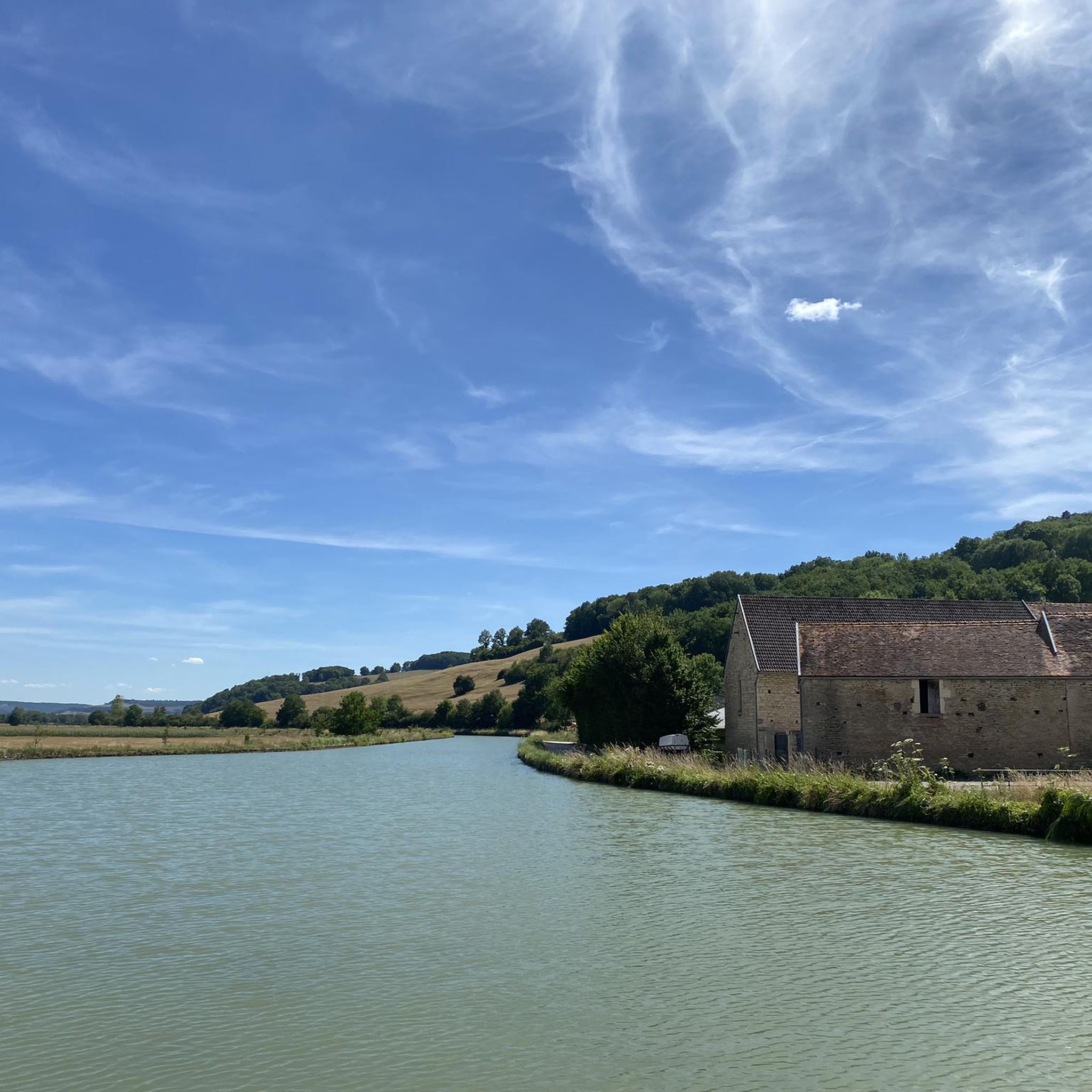
At this point, you exit the D9 and follow the road which runs along the Canal de Bourgogne. This cycle path is very long and famous. There are several places to picnic along the canal.
1
0
A world heritage abbey from the 12th century. Its territory extends over 1200 ha. The Abbey is decorated with a landscaped park classified in 2004 as a “Remarkable Garden” by the National Council of Parks and Gardens. You can book tickets in advance to visit this place on this site: https://www.abbayedefontenay.com the price starts from 9 euros.
2
0
Many, mostly young people, even without any further knowledge of French history. The comic series ASTERIX, which has been translated into many languages around the world, acquaints its readers with this, even though it is (supposedly) not possible to identify this fateful place with a specific location there: “I don't know any Alesia. Nobody knows where this Alesia is," claims Majestix, head of the small Gallic village that successfully resisted the Roman occupiers - thanks to the legendary magic potion of their druid Miraculix - for example in the volume "Asterix and the Avernian Shield".
3
1

La Grande Forge was built in 1786 by Count Buffon. The forge was used for processing iron and was located at a place where it could use the river and later the canals to transport goods and raw materials. Count Buffon built his castle nearby.
2
0
Frequently Asked Questions
What historical sites can I explore around Montigny-Montfort?
The region is rich in history. You can visit the impressive Château de Montfort, an 11th-century feudal castle with a significant past, including housing the Shroud of Turin. Other notable historical sites include the 13th-century Church of St. Martin and the charming Chapelle Saint-Denis. Further afield, don't miss the remarkably preserved 12th-century Cistercian abbey, Fontenay Abbey, a UNESCO World Heritage site, and Buffon's Big Forge, an 18th-century industrial masterpiece.
Are there any natural attractions or unique natural features to see?
Yes, Montigny-Montfort offers several natural points of interest. You can discover Le Trou des Fées (The Fairies' Hole), an intriguing chasm with local folklore. The historic Canal de Bourgogne passes nearby, offering scenic views and opportunities for strolls. For a broader natural experience, the Morvan Regional Natural Park is about 34 km away, providing tranquil countryside ideal for nature lovers.
What are some family-friendly activities in the Montigny-Montfort area?
Many attractions are suitable for families. The Fontenay Abbey and Buffon's Big Forge are both listed as family-friendly. The MuséoParc Alésia, which explains the famous Battle of Alesia, is also a great educational and engaging option for all ages. Exploring the medieval village of Semur-en-Auxois or the town of Montbard with its Parc Buffon can also be enjoyable for families.
What kind of outdoor activities can I do near these attractions?
The area around Montigny-Montfort is excellent for outdoor enthusiasts. You can find numerous hiking trails, with options ranging from easy to moderate. For example, there are several loops around Fontenay Abbey, including a 3.4 km easy loop. Cycling is also popular, with road cycling and touring bicycle routes available, many of which follow the scenic Canal de Bourgogne. You can find more details on routes in the Hiking around Montigny-Montfort and Cycling around Montigny-Montfort guides.
Are there any medieval villages or towns worth visiting nearby?
Absolutely. Semur-en-Auxois, about 9-9.6 km south, is considered one of Burgundy's prettiest medieval villages, known for its lively atmosphere and 14th-century towers, visible from Pont Pinard. Flavigny-sur-Ozerain, approximately 16 km away, is recognized as one of France's most beautiful villages, boasting an ancient center surrounded by fortified walls and a rich history.
What is the best time of year to visit Montigny-Montfort?
The region is beautiful throughout the warmer months. Spring and autumn offer pleasant temperatures for outdoor activities like hiking and cycling, with fewer crowds. Summer (June to August) is also popular, especially around June 21-24 when the Château de Montfort hosts its annual Medieval Festival, featuring the traditional St. John's Fire. Always check specific attraction opening hours, as some may have seasonal variations.
Can I find places to eat or stay near the attractions?
While specific cafes and pubs are not detailed for every attraction, the nearby towns like Montbard (just 5 km away) and the medieval villages of Semur-en-Auxois and Flavigny-sur-Ozerain offer various options for dining and accommodation. Many of these towns cater to tourists exploring the Burgundy region.
Are there any gardens or parks to visit in the vicinity?
Yes, for those who appreciate gardens, the Potager du Château de Lantilly is a remarkable garden located about 4 km from Montigny-Montfort. Another notable garden is the Jardin du Moulin de Athie, found approximately 7 km away. In Montbard, you can also explore the Parc Buffon.
What is the significance of the Château de Montfort?
The Château de Montfort is a historically significant landmark. Originally an 11th-century feudal castle, it was largely rebuilt in the 13th century. It famously housed the Shroud of Turin on two occasions between the 14th and 15th centuries. Today, visitors can explore its impressive southern wall, standing 30 meters high with three semi-octagonal towers, and the remains of the guard room, paved inner courtyard, and ramparts.
How can I get to Montigny-Montfort and its attractions using public transport?
While Montigny-Montfort itself is a small commune, the nearby town of Montbard (5 km away) is a more accessible hub. Montbard has a train station, making it reachable by regional trains. From Montbard, local transport or taxis may be available to reach specific attractions. For detailed planning, it's advisable to check local bus schedules or taxi services from Montbard.
Are there any dog-friendly trails or attractions?
Many of the natural outdoor areas and trails around Montigny-Montfort are generally dog-friendly, especially the hiking and cycling routes along the Canal de Bourgogne or in the Morvan Regional Natural Park. However, it's always best to check specific rules for individual attractions or historical sites regarding pet access before your visit.
What is <a href="https://www.komoot.com/highlight/907933" target="_blank" rel="noopener">MuséoParc Alésia</a> and why should I visit?
MuséoParc Alésia is a museum and archaeological site located approximately 16 km from Montigny-Montfort. It is dedicated to explaining the famous Battle of Alesia, a pivotal event in Gallic history. The site features Roman fortifications and ruins of the ancient Gallo-Roman town, offering a fascinating insight into this historical conflict and the life of the period.
Most popular routes around Montigny-Montfort

Get inspired with the komoot mobile app


Explore more
Still not found the Highlight you’re looking for? See guides of the top attractions in other regions:
