The best road cycling routes around Le Gault-Perche
4.3
(8)
192
riders
83
rides
Road cycling routes around Le Gault-Perche traverse a landscape characterized by undulating terrain, rolling hills, and extensive forests within the Perche Regional Natural Park. The region offers numerous small country roads with minimal traffic, providing a peaceful cycling experience. Le Gault-Perche itself marks the highest point, at 200 meters, along the historic Paris-Tours road cycling race course. The area's varied elevation includes routes with significant gains, catering to different fitness levels.
Best road cycling routes around Le Gault-Perche
- The most…
Last updated: July 2, 2026
2
riders
47.1km
02:08
390m
400m
Moderate road ride. Good fitness required. Mostly well-paved surfaces and easy to ride.
5.0
(1)
6
riders
47.6km
02:31
550m
550m
Moderate road ride. Good fitness required. Some segments of this route may be unpaved and difficult to ride.

Sign up for free
7
riders
82.3km
03:40
750m
750m
Moderate road ride. Good fitness required. Mostly well-paved surfaces and easy to ride.
4.5
(2)
6
riders
Moderate road ride. Good fitness required. Some segments of this route may be unpaved and difficult to ride.
5
riders
64.7km
02:41
340m
340m
Moderate road ride. Good fitness required. Mostly well-paved surfaces and easy to ride.
Get access to more routes and recommendations from other explorers.
Sign up for free
Already have an account?
Our route recommendations are based on thousands of hikes, rides, and runs completed by other people on komoot.
Start today with a free account
Your next adventure awaits.
Login or Signup


Tips from the Community

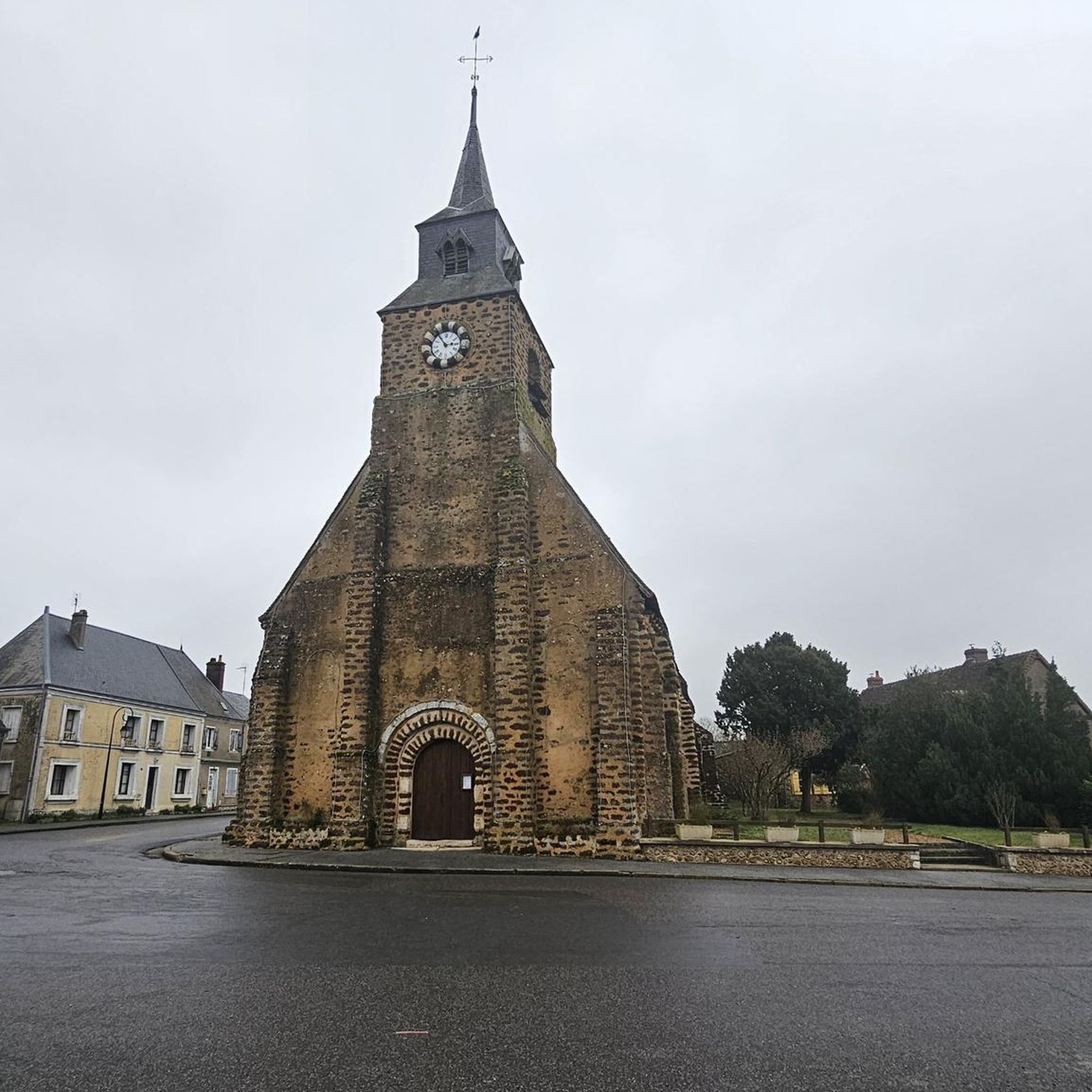
Placed under the patronage of Saint Hilaire, this parish was given by Gannelon de Montigny, lord of the place, to the abbey of Marmoutier around 1042. Its reconstruction probably dates from this period; it then became a priory. The church has a rectangular nave ending in a choir with a flat chevet. An examination of the masonry easily reveals two distinct periods of construction: the Romanesque period and the Renaissance. Built of flint rubble with rendering, the western part of the building appears to date from the 11th or 12th century. A limestone cornice supported by rather crude corbels underlines the base of the roof. To the south, two narrow Romanesque windows flared inwards light the nave. To the north, the bays were later reworked and enlarged. On this same side, a Romanesque doorway was walled up; It allowed the church to connect with a building whose traces of detachment remain. The bell tower was built to the north of the Romanesque nave, extending the western façade. The absence of a connection between the east and west walls of the bell tower and the north wall of the nave clearly indicates that it is an entirely later construction. However, its crowning is much later, as evidenced by its cornice, whose molding is in the classical style. Flanked by obliquely angled buttresses, it is covered with a saddleback roof. The eastern half of the church appears to be an extension built during the Renaissance period. Its ogee-shaped cornice and the decoration of the eastern gable, as well as the moldings of the buttress bands, attest to this dating. A vast rectangular choir then appears to have replaced a semicircular Romanesque apse; the eastern gable and the southern and northern façades were then pierced with networked bays. In the lower part of the north façade, projecting ashlars appear to have supported the roof of a lean-to building. To the south, a sacristy was built in the 19th century. Inside, the entire building is covered with a paneled vault with exposed tie beams and kingposts. The 18th-century high altar is surmounted by an Assumption of the Virgin inspired by Murillo's. For the restoration of the roofs and façades, the Sauvegarde de l'Art Français (French National Art Protection Agency) awarded a grant of €30,490 in 2001.
0
0
The Church of Saint Sauveur La Trinité, probably built in the 12th century, is notable for its Romanesque windows with columns and capitals. On its walls, alternating with the consecration crosses, one can admire a Stations of the Cross in blue enamel on earthenware. The choir is lit by five Romanesque windows decorated with stained glass depicting Our Lord and the four Evangelists.
0
0

The church dates from the 12th century and was remodeled in the 15th or 16th century, its buttresses and bell tower date from the 19th century. It houses a wrought iron communion table from the 18th century.
0
0
In the Middle Ages, Saint-Avit-au-Perche was a priory of the abbey of Saint-Calais, founded by Avit's companion. Today's church dates from the very beginning of the 12th century. It consists of a five-bay nave ending in a semicircular apse. It is covered with chestnut shingles. Several original windows remain; others have been reworked (including the first window, on the north side). This can be seen in the shape of the keystones. A walled-up side door to the south can be seen from the outside. It has an enormous mitre lintel. Inside, it has been transformed into a niche housing Our Lady of Lourdes. The apse is flanked by projecting buttresses. Those at the corners of the façade are from the 15th century. The western portal in a pointed arch is a 15th-century renovation that was completely redone at the end of the 20th century.
0
0
From its source to its confluence with the Ozanne, the Sainte-Suzanne covers 19.2 km and crosses 5 communes. From upstream to downstream: Authon-du-Perche; Beaumont-les-Autels; Coal pits; Les Altars-Villevillon; A glass.
0
0
Building built in the 15th century, ribbed vaulted, with straight apse; beginning of the 16th century, c. 1530, construction of the Sainte-Barbe chapel on the south side; Renaissance stained glass, not. Tree of Jesse (surviving fragments); 17th century altarpiece and high altar. History of protection: the classification order of April 25, 2003 replaces the classification order of February 11, 1911 and the registration orders on the supplementary inventory of historic monuments of January 20, 1926 and February 4, 2002.
0
0
the Saint-André church dates from the 11th century; it was a priory then dependent on the abbey of St.-Calais, but the current building was completely rebuilt around the walls and framework of the old building. The project was carried out in 1877. The construction of a transept, enlarged windows and a stone bell tower completely modified the old monument. The environment has also changed a lot. All traces of the old cemetery, transferred outside the village at the beginning of the 18th century, have disappeared. The furniture includes a stone baptistery, a statue of the Virgin and Child, a confessional and a Louis XV period bench. The beautiful wooden tabernacle decorated with a statue of Saint Lubin comes from the church which was located a few kilometers away, in Saint-Lubin-des-Cinq-Fonts, and of which only the choir, which has become a chapel, remains today. .
0
0
Frequently Asked Questions
How many road cycling routes are available around Le Gault-Perche?
There are over 75 road cycling routes around Le Gault-Perche, offering a wide range of options for different skill levels and preferences. These routes traverse the picturesque landscapes of the Perche Regional Natural Park.
What kind of terrain can I expect when road cycling in Le Gault-Perche?
The terrain around Le Gault-Perche is predominantly undulating, characterized by rolling hills and extensive forests. While not mountainous, the region offers magnificent views and routes with elevation gains that can exceed 1,000 meters, providing a good challenge without arduous mountain passes. Le Gault-Perche itself is the highest point, at 200 meters, along the historic Paris-Tours road cycling race course.
What is the best time of year for road cycling in Le Gault-Perche?
Road cycling in Le Gault-Perche is accessible year-round. However, spring, summer, and autumn are generally considered more pleasant for longer rides, offering milder weather and vibrant scenery.
Are there quiet roads for cycling in Le Gault-Perche?
Yes, the region is well-known for its numerous small country roads with minimal traffic, providing a peaceful and scenic cycling experience. You can explore the 'Routes tranquilles du Perche' (the quiet routes of the Perche), a network of dedicated loops designed for tranquil rides.
Are there easy road cycling routes suitable for beginners in Le Gault-Perche?
Yes, among the 76 available routes, 33 are classified as easy, making them suitable for beginners or those looking for a more relaxed ride. These routes are part of the network that caters to various fitness levels.
Can I find road cycling routes around 50km in length?
Absolutely. Many routes in the region are around the 50km mark. For example, the Châteaux and Seigneuries of Perche Loop is 47.1 km, and the Château de Montmirail – Montmirail Castle loop from Le Plessis-Dorin is 47.6 km, both offering moderate challenges.
Are there longer road cycling routes for advanced cyclists?
Yes, for advanced cyclists seeking longer distances and more elevation, routes like the Stage 1 of the Véloscénie – Château de Montmirail loop from Arville, at 82.3 km with significant elevation, provide a good challenge. The region also features routes with elevation gains exceeding 1,000 meters for those with very good fitness.
What scenic viewpoints or natural features can I discover while cycling in Le Gault-Perche?
The landscape offers a picturesque blend of forests and rolling hills, providing an unspoiled natural environment. You'll cycle through the protected Perche Regional Natural Park, enjoying tranquil rural scenery and panoramic views from various points along the undulating roads.
Are there any historical or cultural landmarks along the road cycling routes?
Yes, beyond the natural beauty, you can discover charming villages, historic manors, and abbeys. Notable religious buildings include the Notre-Dame Church of Chapelle-Guillaume, Saint Anne Church, and the Saint-Jean-Baptiste Church of Courtalain. The Ruins of Guériteau Chapel also offer a glimpse into the region's history.
What do other road cyclists enjoy most about cycling in Le Gault-Perche?
The area is highly rated by the komoot community, with an average score of 4.3 stars from over 8 reviews. Cyclists often praise the quiet country roads, the scenic rolling hills, and the extensive forests that define the region's routes, making for a peaceful and enjoyable experience.
Are there family-friendly road cycling routes in Le Gault-Perche?
While specific 'family-friendly' designations aren't always explicit for road cycling, the presence of numerous small country roads with minimal traffic makes many of the easier routes suitable for families with older children who are comfortable with road cycling. Always check the route difficulty and elevation profile to ensure it matches your family's capabilities.
Where can I find cafes or accommodation along the cycling routes?
The charming villages scattered throughout the Perche region often host local cafes, restaurants, and various accommodation options. Planning your route to pass through these villages will allow for convenient stops to refuel and rest. The region also offers opportunities to visit educational farms and taste traditional cider, adding a local flavor to your stops.
Most popular attractions around Le Gault-Perche

Get inspired with the komoot mobile app


Explore more
Browse the best Road cycling routes in other regions.
