The best road cycling routes around Buno-Bonnevaux
4.5
(52)
1,455
riders
180
rides
Road cycling routes around Buno-Bonnevaux traverse a serene natural environment within the Natural Regional Park of Gâtinais français. The region features diverse landscapes, including the banks of the Essonne River and surrounding woods, which are recognized as sensitive natural areas. Cyclists encounter varying elevations, with some routes offering significant climbs, and well-paved surfaces are common. The area provides a mix of moderate and challenging paths suitable for different fitness levels.
Best road cycling routes around Buno-Bonnevaux
- The most popular road…
Last updated: November 5, 2026
3.0
(1)
17
riders
Hard road ride. Very good fitness required. Mostly well-paved surfaces and easy to ride.
14
riders
52.3km
02:10
300m
300m
Moderate road ride. Good fitness required. Mostly well-paved surfaces and easy to ride.

13
riders
90.5km
03:47
470m
470m
Moderate road ride. Good fitness required. Some segments of this route may be unpaved and difficult to ride.
4.0
(1)
10
riders
Moderate road ride. Good fitness required. Mostly well-paved surfaces and easy to ride.
5.0
(2)
8
riders
Moderate road ride. Good fitness required. Mostly well-paved surfaces and easy to ride.
Get access to more routes and recommendations from other explorers.
Already have an account?
Our route recommendations are based on thousands of hikes, rides, and runs completed by other people on komoot.
Start today with a free account
Your next adventure awaits.


Tips from the Community


Former market square in the heart of Milly-la-Forêt.
1
0

The chapel was built in 1313 by Hugues de Bouville. In the 18th century, it was abandoned. It was finally sold as national property during the Revolution. It was restored in 1861 and 1974. Between 1909 and 1910, it was the object of major pilgrimages in memory of Saint Vincent de Paul.
0
0

On the way to the castle of Fontainebleau you can see it in several places coming from the south. The continuation of it can also be seen between Pont-sur-Yonne and Sens (Aqueducs de la Vanne et de l'Yonne)
0
0

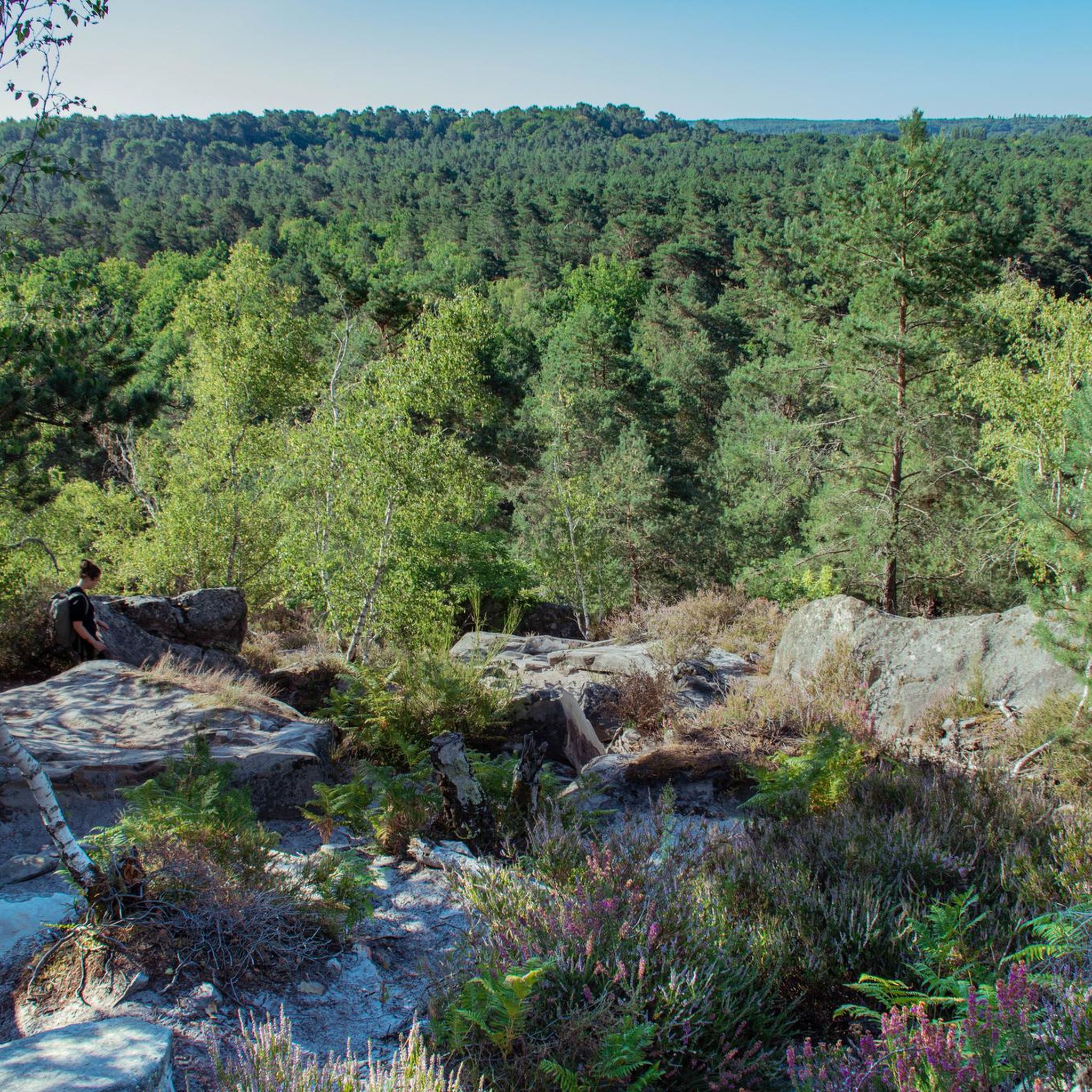
Stop at the edge of town to admire the view
0
0

This door, which appears medieval, does not go unnoticed with its two towers and the battlements of its curtain wall. Make no mistake, it was built in 1928 on the initiative of Mrs. Belmont, an American national, then owner of the Augerville castle. This gate now belongs to the commune of Boulancourt.
0
0

The trail moves on to the main essentials The hall In 1479, by a special grace from Louis The North-South facing Hall, 46 m long, 16 m wide and 13 m high, covers a total surface area of 730 m2. 48 oak pillars, resting on “dice”-cut stone bases, support a chestnut frame typical of Ile-de-France at that time; this frame presents to the north (on the rue Langlois side) a “pavilion” farm. Today, La Halle is still the site of a market on Thursday afternoons. The square, the houses gathered all around, bear witness to the great commercial activity which already reigned in the region 500 years ago. La Halle has been classified as a Historic Monument since 1923. Bonde Castle is located near the town center of Milly-la-Forêt, Built near an artificial island in the l'École river to the west of the Notre-Dame collegiate church, its park is bordered to the west by the course of the river which forms a moat to the north protecting the châtelet. History Built in the 12th century by the lords of Milly, the castle was ruined during the English siege in 1432. At the end of the 15th century around 1475, owned by Admiral Louis Malet de Graville, it was rebuilt and enlarged. What was then the keep became the entrance gatehouse, the drawbridge was replaced by a permanent stone bridge and a gate closed access between the northern defense tower and the governor's house. A square courtyard was surrounded by a wall and had in the center a chapel dedicated to Saint Valentine. The castle was successively the property of Hugues III de Bouville, Olivier V de Clisson, Jean II de Montmorency, Jean-François de Faudoas d'Averton, Marc-Antoine Front de Beaupoil de Saint-Aulaire and Pierre Marie of Lau d’Allemans. In the 19th century, the towers of the chatelet were enhanced with brick battlements and a slender roof. In 1859 the Corne bridge was rebuilt near the castle washhouse which served as a watering trough for the animals. At the end of the 20th century the mills along the river were demolished. In 1964, the Bonde washhouse downstream of the river which was part of the estate was rehabilitated. On December 20, 1972, the castle was partly listed as a historic monument. The park was listed in 1991 for its fences, canals and paths. the house of Jean Cocteau. Entrance to the J. Cocteau house [This 17th century residence, flanked by turrets, was formerly called the Governor's House. It corresponds to an old outbuilding of the castle in front of which the vassals came to pay homage and faith to their lord. Jean Cocteau bought this house with Jean Marais in 1947 and lived there until his death. Notre-Dame de l’Assomption Church Founded in the 11th century, the former chapel of the castle, it was rebuilt around 1485 on the orders of Admiral de Graville in the Gothic style of the 13th and 14th centuries. The bell tower, 57 meters high, dates from the 11th century in its lower part and from the 12th and 13th centuries in its upper part. The arch of the main portal in the primitive Romanesque style comes from an old church in Milly (Saint-Pierre or Saint-Jacques). On the east side of the bell tower - Place Grammont side - the arms of Admiral de Graville are still visible. Many works of sacred art are found inside the church. The church was listed as a Historic Monument in 1926. The dovecote; Located on the old triangular square of the dovecote cul de sac, this old building was part of the Domaine du Moustier, property of Fulbert I, lord of Milly and officer at the court of Dagobert I in the 7th century. Destroyed in 1432 or 1433, the complex included a vast farm. According to a count in 1792 it had around 1200 niches. Only the lords held the right to build these premises designed for breeding. The Moustier de Péronne gate is one of the oldest vestiges of Milly and dates from the 7th century. It provided access to the moustier (monastery in old French) owned by Fulbert I, who obtained the land of Milly from Dagobert I. His son Wulfran was born there around the year 635. Entering religion, he became the apostle of the frieze (Netherlands), then bishop of Sens before retiring to Saint Wandrille where he died in 720.
1
0
Frequently Asked Questions
How many road cycling routes are available in Buno-Bonnevaux?
Buno-Bonnevaux offers a good selection of road cycling routes, with over 20 routes available. These routes cater to various fitness levels, including 3 easy, 17 moderate, and 2 difficult options.
Are there challenging road cycling routes with significant elevation gain around Buno-Bonnevaux?
Yes, for experienced cyclists seeking a challenge, Buno-Bonnevaux offers routes with significant elevation gain. For example, the Château du Marais – Villeconin Castle loop from Buno - Gironville is a difficult route with nearly 1,000 meters of ascent, often taking over 4 hours to complete.
What kind of scenery can I expect on road cycling routes in Buno-Bonnevaux?
The road cycling routes in Buno-Bonnevaux traverse a serene natural environment within the Natural Regional Park of Gâtinais français. You'll encounter diverse landscapes, including tree-lined roads, the banks of the Essonne River, and surrounding woods. Peaceful ponds also dot the landscape, offering picturesque views.
Are there historical landmarks or cultural sites to see along the road cycling routes?
Absolutely. The region is rich in history and culture. Routes often pass by historical sites such as the Saint Lubin Chapel, as seen on the Saint Lubin Chapel – Yèvre-le-Châtel loop from Buno - Gironville. You can also explore various châteaux, ancient wash-houses along the Essonne River, and even vestiges dating back to the Mesolithic and Neolithic eras. Notable highlights include the Milly-la-Forêt area and the Domaine de Courances.
Are most road cycling routes around Buno-Bonnevaux loop trails?
Many of the popular road cycling routes around Buno-Bonnevaux are designed as loops, allowing you to start and finish at the same point. Examples include the Descent to Bonnevaux – The Elephant loop from Buno - Gironville and the Milly-la-Forêt Church – Grez-sur-Loing Beach loop from Buno - Gironville.
What do other road cyclists enjoy the most about road cycling in Buno-Bonnevaux?
The road cycling experience in Buno-Bonnevaux is highly rated by the komoot community, with an average score of 4.6 stars from over 17 reviews. Cyclists often praise the serene natural environments, the well-paved surfaces on many segments, and the opportunity to combine physical activity with cultural enrichment by passing historical sites.
Are there any easy road cycling routes suitable for beginners or a more relaxed ride?
Yes, Buno-Bonnevaux offers 3 easy road cycling routes perfect for beginners or those looking for a more relaxed pace. These routes provide a gentle introduction to the region's beautiful landscapes without demanding high fitness levels.
What are some natural features or monuments I can see while cycling?
Beyond the Essonne River and its sensitive natural areas, you can discover several natural monuments and unique features. These include the intriguing The Cyclop, the sandy landscapes of Les sables du Cul de Chien, and the distinctive Turtle Rock.
Are there any long-distance road cycling routes for endurance training?
Yes, for those looking for longer rides, Buno-Bonnevaux has routes exceeding 90 km. The Beautiful route through the trees – Saint Martin's Church loop from Buno - Gironville, for instance, is over 110 km long, offering an extended journey through the region's scenic landscapes.
What other activities are available in Buno-Bonnevaux besides road cycling?
Buno-Bonnevaux offers a variety of activities. The village hosts one of France's most important gliding centers, the Association Aéronautique du Val d'Essonne, where first flights are available. You can find more information about gliding at AAVE Planeurs de Buno-Bonnevaux. Nearby, you can also find accrobranche (tree-top adventure courses) in Milly-la-Forêt and various equestrian centers for horse riding.
Is Buno-Bonnevaux a good destination for a cycling holiday with varied interests?
Yes, Buno-Bonnevaux is an excellent destination for a cycling holiday with varied interests. Its combination of well-maintained cycling routes, protected natural areas, rich historical sites, and diverse recreational opportunities like gliding and tree-top adventure courses ensures there's something for everyone to enjoy.
Are there any specific routes that pass through particularly scenic tree-lined roads?
Many routes in the region offer beautiful tree-lined sections, enhancing the cycling experience. The Beautiful route through the trees – Saint Martin's Church loop from Buno - Gironville explicitly highlights this feature, promising a scenic ride through the woods.
Most popular routes around Buno-Bonnevaux
Most popular attractions around Buno-Bonnevaux

Get inspired with the komoot mobile app


Explore more
Browse the best Road cycling routes in other regions.
