The best road cycling routes around Dannemarie
4.6
(63)
1,930
riders
236
rides
Road cycling routes around Dannemarie are characterized by a diverse landscape, offering options from flat canal paths to undulating hills. The region features the scenic Rhône-Rhine Canal, providing level terrain for relaxed rides, and the Largue Valley with its greenways and ponds. Cyclists can also explore routes through wooded areas and the gently rolling Sundgau Hills, which offer varied ascents and descents. This topography provides a range of experiences for road cyclists of different skill levels.
Best road cycling routes…
Last updated: July 2, 2026
5.0
(1)
137
riders
203km
08:34
1,430m
1,430m
Hard road ride. Very good fitness required. Some segments of this route may be unpaved and difficult to ride.
5.0
(2)
30
riders
85.7km
03:28
470m
470m
Moderate road ride. Good fitness required. Mostly well-paved surfaces and easy to ride.

Sign up for free
4.0
(1)
30
riders
59.2km
02:27
320m
320m
Moderate road ride. Good fitness required. Mostly well-paved surfaces and easy to ride.
21
riders
7.11km
00:19
40m
40m
Easy road ride. Great for any fitness level. Mostly well-paved surfaces and easy to ride.
14
riders
80.5km
03:33
560m
560m
Moderate road ride. Good fitness required. Mostly well-paved surfaces and easy to ride.
Get access to more routes and recommendations from other explorers.
Sign up for free
Already have an account?
Our route recommendations are based on thousands of hikes, rides, and runs completed by other people on komoot.
Start today with a free account
Your next adventure awaits.
Login or Signup



Tips from the Community

The Moulin de Mormoulins is a watermill located on the Eure River in the hamlet of Mormoulins. This mill dates back to the 18th and 19th centuries and is a listed historical monument. You can admire the old stone building, the wooden wheel, and the canal that diverts water from the river as you pass in front of the mill. The mill is surrounded by green fields and trees, creating a peaceful and relaxing atmosphere.
0
0


According to tradition, the church choir covers the remains of an older building, possibly dating back to the 6th century, which was built to house the saint's body. According to current knowledge, the commune of Saint-Piat (Sanctus Piatus in Latin) officially appeared in 1087, mentioned in a charter of the Nottonville Priory (Eure-et-Loir), on which it depended. The current building was rebuilt during the time of Francis I, as suggested by the date 1535 engraved on two buttresses of the apse and the date 1542 engraved on a piece of wood from the vault. This is according to a study by the SAEL (Eure-et-Loir Archaeological Society). The three-sided apses, the dripstone towers (horizontal members projecting from a wall), and the sculpted roof structures are a testament to the importance of the reconstructions carried out in the department during the 16th century. The church of Saint-Piat is one of them. While the church has not been officially recognized, it nevertheless contains objects that have attracted attention both for their antiquity and quality, but not always for good reason. Their artistic value, far from attracting only religious or aesthetic interest, has also aroused a covetousness that, unfortunately, remains for some of them. Fortunately, those still in place are carefully cared for and offer the curious a story to discover, a beauty to slowly ponder as they progress toward the choir.
0
0

Beautiful castle with a beautiful forest nearby 😉
0
0


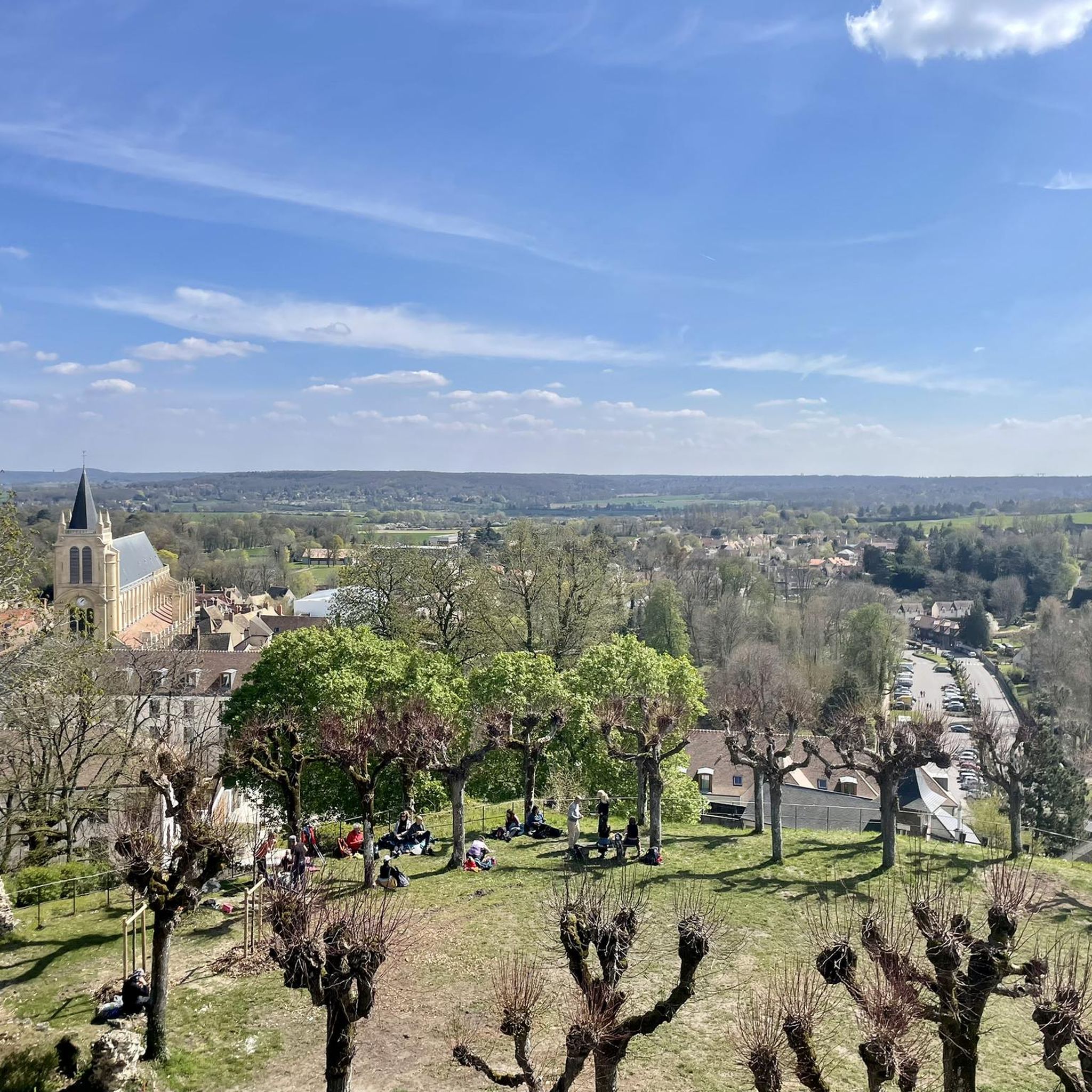
a pretty little village not to be missed in the Yvelines: you wouldn't think you were in the suburbs of Paris!
0
0
Church of Saint Peter and Saint Paul The construction of the church is said to have been initiated by Don Roger, abbot of the very powerful Benedictine abbey of Coulombs from 1115 to 1174. At that time, the abbey stood near Nogent-le-Roi, a former fortified town located twelve kilometers away on the banks of the Eure. Spread over more than 80 parishes, it had a considerable influence in the region until the Revolution, whether from a religious, economic or social point of view. The Romanesque style that it had adopted since its original construction was reworked in the 16th century by the opening of tall Gothic windows around the choir. Finally, in the following century, during the Wars of Religion, the church suffered serious damage. When peace returned, the entrance porch was finally rebuilt in the elegant Renaissance style. In 1950, a fire destroyed the church and all its furniture; it was restored at the end of the 20th century.
0
0

Beautiful little village, typical of the region.
0
0
Frequently Asked Questions
What types of road cycling routes can I find around Dannemarie?
Dannemarie offers a diverse landscape for road cyclists. You'll find flat, scenic paths along the Rhône-Rhine Canal, greenways through the Largue Valley with its ponds and charming Sundgauvian villages, and routes through gently undulating Sundgau Hills and wooded areas like the Bois de Gevrey, providing varied ascents and descents.
How many road cycling routes are available in the Dannemarie area?
There are over 240 road cycling routes around Dannemarie, catering to various skill levels. This includes approximately 85 easy routes, over 140 moderate routes, and 14 more challenging options.
Are there any easy road cycling routes suitable for beginners or relaxed rides?
Yes, for an easy and relaxed ride, consider the Roadbike loop from Dannemarie, which is about 7 km long. The flat paths along the Rhône-Rhine Canal are also ideal for leisurely cycling, offering scenic views and minimal ascent.
What kind of elevation gain can I expect on road cycling routes in Dannemarie?
The elevation gain varies significantly. Flat canal-side routes offer minimal ascent, while routes through the Sundgau Hills and undulating ridges provide more athletic challenges with notable climbs and descents. For example, the difficult Château de Mormoulins – Porte Saint Denis loop from Houdan features over 1,400 meters of elevation gain.
Are there any circular road cycling routes around Dannemarie?
Many routes in the region are designed as loops. For instance, the Vilpert Ponds – Croix de Vilpert Monument loop from Houdan is a moderate 57 km circular route, and the Behoust Castle – Croix de Vilpert Monument loop from Houdan offers a longer 80 km option.
What do other road cyclists think about the routes in Dannemarie?
The road cycling routes around Dannemarie are highly rated by the komoot community, with an average score of 4.5 stars from over 50 reviews. Cyclists often appreciate the varied terrain, from peaceful canal paths to rolling hills, and the charming villages encountered along the way.
Are there any attractions or points of interest along the road cycling routes?
Yes, many routes pass by interesting landmarks. You might encounter historical sites like The Donjon of Houdan, charming structures such as the beautiful church of Prouais, or picturesque bridges like Pont de Gambaiseuil. The routes also often wind through typical Sundgauvian villages, offering opportunities to experience local culture.
Can I find shaded routes for cycling during warmer weather?
Absolutely. The region features extensive wooded areas, such as the Bois de Gevrey, which provide welcome shade on many routes. The Largue Valley greenway is also described as shaded, making it pleasant for summer cycling.
Are there any routes that follow waterways?
Yes, the Rhône-Rhine Canal is a prominent feature, offering flat and scenic paths perfect for cycling. The Largue Valley cycle route also follows the Largue river, winding through its valley with numerous ponds.
Where can I find more information about cycling in the broader Alsace region?
For additional information on cycling in the wider Alsace region, including the Sundgau, you can visit the official tourism website: visit.alsace.
Are there any longer, more challenging road cycling routes for experienced riders?
For experienced riders seeking a challenge, the Château de Mormoulins – Porte Saint Denis loop from Houdan is a difficult route spanning over 200 km with significant elevation gain. Other moderate to difficult routes through the Sundgau Hills also offer varied terrain and longer distances.
Can I find places to stop for refreshments along the routes?
Yes, especially along the Rhône-Rhine Canal, you'll find amenities like the Relais du Port in Dannemarie, which offers waterside terraces perfect for a break. Many routes also pass through charming Sundgauvian villages where you can find local cafes and restaurants.
Most popular routes around Dannemarie
Most popular attractions around Dannemarie

Get inspired with the komoot mobile app


Explore more
Browse the best Road cycling routes in other regions.
