Attractions and Places To See around Auragne - Top 20
Best attractions and places to see around Auragne include its rural landscapes and historical connections within the Haute-Garonne department of the Occitanie region. This commune is part of the historic Lauragais area, known for its agricultural past in pastel cultivation and grain production. Auragne serves as a base for exploring nearby points of interest and natural features, characterized by rolling hills and agricultural lands.
Best attractions and places to see around Auragne
- The most popular attraction is Trail of the…
Last updated: June 23, 2026
Trail of the Notre-Dame des Bois Chapel
Highlight • Trail
La petite statue en bois polychrome a été datée du début du XIIIe siècle d'après son style qui est celui des …
Tip by

Moulin de Montbrun-Lauragais
Highlight • Monument
The equipment services or I don't know which service provider had the great idea of digging a mini trench for …
Translated by Google •
Tip by

Sign up now to discover places like this
Get recommendations on the best single tracks, peaks, & plenty of other exciting outdoor places.
Sign up for free
Montesquieu-Lauragais Village
Highlight • Settlement
The village was born from a feudal castle dating back probably to the beginning of the 10th century. A very old document reveals that in 1162, the …
Translated by Google •
Tip by

Montgeard and its church
Highlight • Other
Translated by Google •
Tip by
Pilgrims' hostel near Ayguesvives
Highlight • Other
Translated by Google •
Tip by

Sign up for free to discover even more attractions around Auragne.
Sign up for free
Already have an account?
Start today with a free account
Your next adventure awaits.
Login or Signup



Tips from the Community


It is absolutely essential to notify the Toulouse town hall, highway department.
1
0

Very beautiful church, typical of the southwest.
0
0

A pilgrims' hostel run by the Association of Friends of the Way of St. James Occitaine in a former lock keeper's house. Since April 2023, pilgrims with ID / Credencial can stay here for €17 per night. Breakfast is available for a donation. There are 14 places. It is advisable to reserve the evening before. The surroundings are very beautiful. Unfortunately, the traffic from the nearby motorway is very loud outside. ---- Gîte d'étape à Ayguesvives Ecluse du sanglier 31450 AYGUESVIVES Tel : +33 5 34663009 https://www.chemins-compostelle.com/hebergeur/fiche/1256/ayguesvives-gite-d-etape-haute-garonne-occitanie
0
0
Be careful on the descent from Montbrun towards Lacroix Falgarde!!! The equipment services or I don't know which service provider had the great idea of digging a mini trench for the optical fiber or something of that kind on the right lane, therefore in the direction of descent. It's very poorly sealed, there are lots of hills or potholes. It's extremely dangerous for cyclists given the speed reached on this steep descent. I would even say more, it's criminal to do such a disgusting job. I don't know if there are plans to fix this road, but it would be really urgent. And this type of trench is found on several roads in this sector. On the D35 in particular, be careful!
3
0

A castle village The village was born from a feudal castle dating back probably to the beginning of the 10th century. A very old document reveals that in 1162, the town bore the name of “Monteschivum”, made up of “mont” and a qualifier from the German word “esquiu”, which in Old French gave “eschiu”, c ' that is to say: wild, hostile, fierce. The village was called "Montesquieu" until 1797, then "Montesquieu-sur-le-Canal" and finally Montesquieu-Lauragais since 1889. At the top of the hill ... Montesquieu was installed on a height, to be easy to defend and favorable to the surveillance of the surroundings. Until the 13th-14th century, the region was covered by a thick forest (from Montaudran to Naurouze), a landmark for many brigands. The systematic clearing of this forest began with the installation of bastides in the 13th century, such as those of Villenouvelle, Saint-Rome and Villefranche. In the 18th century, the Hers pipeline accelerated its disappearance. A turbulent history In the 12th-13th century, Montesquieu was a hotbed of Catharism, with a dozen Cathar “houses” and even a Cathar cemetery, perhaps located in Le Rouquet. During the religious wars of the 16th century, the village was Protestant like many others in the region. After a siege of ten days, the Duke of Joyeuse and his Catholic troops reconquer it and completely destroy it in 1586. The inscription preserved next to the entrance to the sacristy proves that the work of reconstruction of the church , and undoubtedly from the village, began as early as 1600. Pastel blue In the 15th and 16th centuries, the pastel grew in a land of Laurentians certainly better than today, impoverished by the wheat-corn rotation which made the glory of the Toulouse region from 1820 to 1880. Written sources mention Montesquieu as a place of purchase of pastel between 1450 and 1540. They indicate the existence of “botigas del pastel” and pastelier mills. They numbered 16 at the beginning of the 15th century and another 9 in the 17th century.
1
1
Source Wikipedia: The Church of Notre-Dame-de-l'Assomption de Montgeard was built for the most part between 1522 and 15612, during the heyday of pastel culture in Lauragais. It has benefited from large donations from local families enriched by this business. In this, this "pastel church" testifies to the golden age of the "land of plenty" during the Renaissance. A funerary case intended to house the tombs of the main pastoral merchant families in the area, the church was in particular to celebrate the rise of the most powerful of them, the Durands, who at the same time became Lords of Montgeard. Following the southern Gothic style, the building surprises with the contrast between its very stripped and defensive exterior and the richness of its interior decoration, in particular sculpted. Its vault, painted in the 19th century in imitation of that of the cathedral of Sainte-Cécile d´Albi, earned it its nickname "Little Albi". The church of Montgeard and its bell tower were classified as a historic monument by decree of April 25, 1890.
0
0

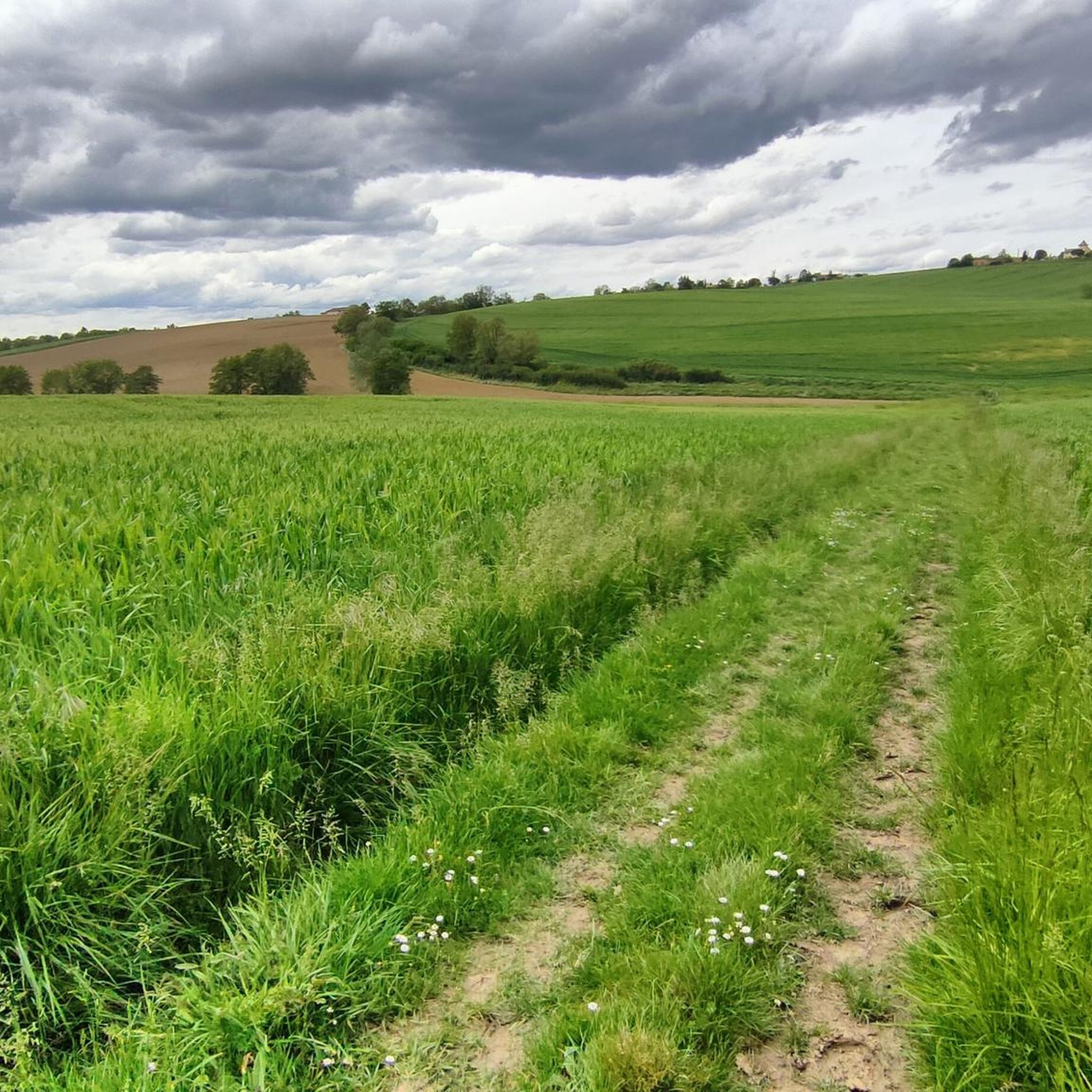
A very pleasant single, rather rolling, shaded. Can be wet ...
3
0
Frequently Asked Questions
What historical sites can I visit near Auragne?
Auragne is situated in the historic Lauragais region, offering several points of interest. You can explore the Montesquieu-Lauragais Village, known for its feudal castle and rich history, including connections to Catharism and the pastel trade. Another significant site is the Moulin de Montbrun-Lauragais, a man-made monument providing insight into the region's agricultural heritage. Additionally, the village of Montgeard and its church are notable for their architecture and history tied to the pastel trade.
Are there any trails or natural features to explore around Auragne?
Yes, the area around Auragne offers rural landscapes and trails. A popular option is the Trail of the Notre-Dame des Bois Chapel, which leads to a historic chapel and is known for its pilgrimage tradition. The region is characterized by rolling hills and agricultural lands, with the Tédèlou stream flowing through the commune, providing a pleasant natural setting for walks.
What outdoor activities can I do near Auragne?
The rural setting around Auragne is ideal for various outdoor activities, particularly cycling and mountain biking. You can find numerous routes for road cycling, touring cycling, and MTB trails. These routes often pass through charming villages and scenic agricultural landscapes. For example, you can explore routes like 'Between Cintegabelle and Nailloux' for road cycling or 'Around Clermont-le-Fort' for touring cycling.
Are there family-friendly attractions around Auragne?
While Auragne itself is a small rural community, the nearby Moulin de Montbrun-Lauragais is considered family-friendly and offers an educational glimpse into the region's agricultural past. The general rural environment also provides opportunities for family walks and bike rides on less challenging routes, allowing children to enjoy the outdoors.
What is the best time to visit Auragne and its surrounding attractions?
The Lauragais region, including Auragne, is best enjoyed during the spring and autumn months. The weather is typically mild and pleasant, ideal for exploring historical sites and engaging in outdoor activities like cycling and walking. Summers can be warm, but still suitable for early morning or late afternoon excursions. Winters are generally mild but may limit some outdoor pursuits.
How can I get to the attractions around Auragne, and is parking available?
Auragne and its nearby attractions are best accessed by car, as public transport options are limited in this rural area. Most villages and sites will have designated parking areas, especially for popular attractions. For specific trails or smaller sites, roadside parking might be available. Always check local signage for parking regulations.
Are there any unique cultural experiences in the Auragne area?
The Auragne area, part of the Lauragais, is steeped in the history of the pastel trade, which brought significant wealth and cultural development to the region. Visiting villages like Montesquieu-Lauragais and Montgeard allows you to see architecture and sites directly influenced by this historical period, offering a unique cultural insight into the 'Pays de Cocagne'.
What do visitors enjoy most about the attractions near Auragne?
Visitors particularly appreciate the blend of historical significance and natural beauty. The Trail of the Notre-Dame des Bois Chapel is praised for its scenic beauty and historical narrative. The charm of the rural villages like Montesquieu-Lauragais and the historical context of sites like the Moulin de Montbrun-Lauragais are also highly valued, offering a peaceful and enriching experience away from bustling cities.
Are there any pilgrim routes or religious sites near Auragne?
Yes, the region has connections to pilgrim routes. The Trail of the Notre-Dame des Bois Chapel is known for its pilgrimage tradition. Additionally, near Ayguesvives, there is a pilgrims' hostel run by the Association of Friends of the Way of St. James Occitaine, indicating the presence of pilgrim paths in the wider area.
Can I find dog-friendly walks near Auragne?
The rural nature of Auragne and the surrounding Lauragais region makes it generally dog-friendly for walks. Many of the local paths and trails, including the Trail of the Notre-Dame des Bois Chapel, are suitable for walking with dogs, provided they are kept under control. Always ensure to respect local regulations and clean up after your pet.
What are some notable nearby towns to visit from Auragne?
Auragne serves as a good base for exploring larger neighboring towns. Toulouse, approximately 24 km away, offers numerous attractions like the Cité de l'Espace, Place du Capitole, and the Canal du Midi. Closer options include Auterive (approx. 5 km), Carbonne (approx. 25 km), and Rieux-Volvestre (approx. 29 km), which are known for their historical significance and local charm.
Most popular routes around Auragne

Get inspired with the komoot mobile app


Explore more
Still not found the Highlight you’re looking for? See guides of the top attractions in other regions:
