The best road cycling routes around Houville-La-Branche
4.4
(78)
1,790
riders
268
rides
Road cycling routes around Houville-La-Branche traverse the varied landscapes of the Eure-et-Loir department, offering a mix of terrain. The region features the expansive, agricultural plains of the Beauce and the more undulating, green hills of the Perche. Cyclists can find routes along tranquil river valleys, such as the Eure and Loir, and through areas with woodlands.
Best road cycling routes around Houville-La-Branche
- The most popular road cycling route is Esclimont Castle – Armenonville church loop from Champseru, a 31.6…
Last updated: November 1, 2026
13
riders
53.0km
02:07
250m
250m
Moderate road ride. Good fitness required. Mostly well-paved surfaces and easy to ride.
4
riders
25.8km
01:03
130m
130m
Easy road ride. Mostly well-paved surfaces and easy to ride.

7
riders
Easy road ride. Mostly well-paved surfaces and easy to ride.
4.0
(2)
4
riders
Easy road ride. Mostly well-paved surfaces and easy to ride.
5.0
(1)
8
riders
36.7km
01:32
150m
150m
Easy road ride. Mostly well-paved surfaces and easy to ride.
Get access to more routes and recommendations from other explorers.
Already have an account?
Our route recommendations are based on thousands of hikes, rides, and runs completed by other people on komoot.
Start today with a free account
Your next adventure awaits.




Tips from the Community

This 13th-century portal is an example of pure Gothic style. The quality of the rafter frame forming trusses, with sculpted king posts, should be highlighted. The lord of Prunay, Louis de Billy, was behind its establishment from 1541 to 1547.
0
0
The Saint-Lubin church of Coltainville is a religious monument located in the commune of Coltainville, in the Centre-Val de Loire region. Although its name suggests a dedication to Saint Lubin, bishop of Chartres in the 6th century, the available sources do not specify its period of construction or its detailed history. This type of building, typical of the French countryside, often plays a central role in local life, both spiritually and communally. In the general context of the Centre-Val de Loire, parish churches like that of Coltainville were historically essential gathering places. They served not only for religious services, but also for social events, such as baptisms, weddings, or village assemblies. Their architecture and decoration often reflect local resources and know-how, as well as regional or national stylistic influences depending on the era.
0
0
In the 15th century, the original church, probably from the 12th century, was burned down. During the reconstruction, a side aisle was added. The bell tower dates from the late 19th century, as do the painted motifs on the walls.
0
0
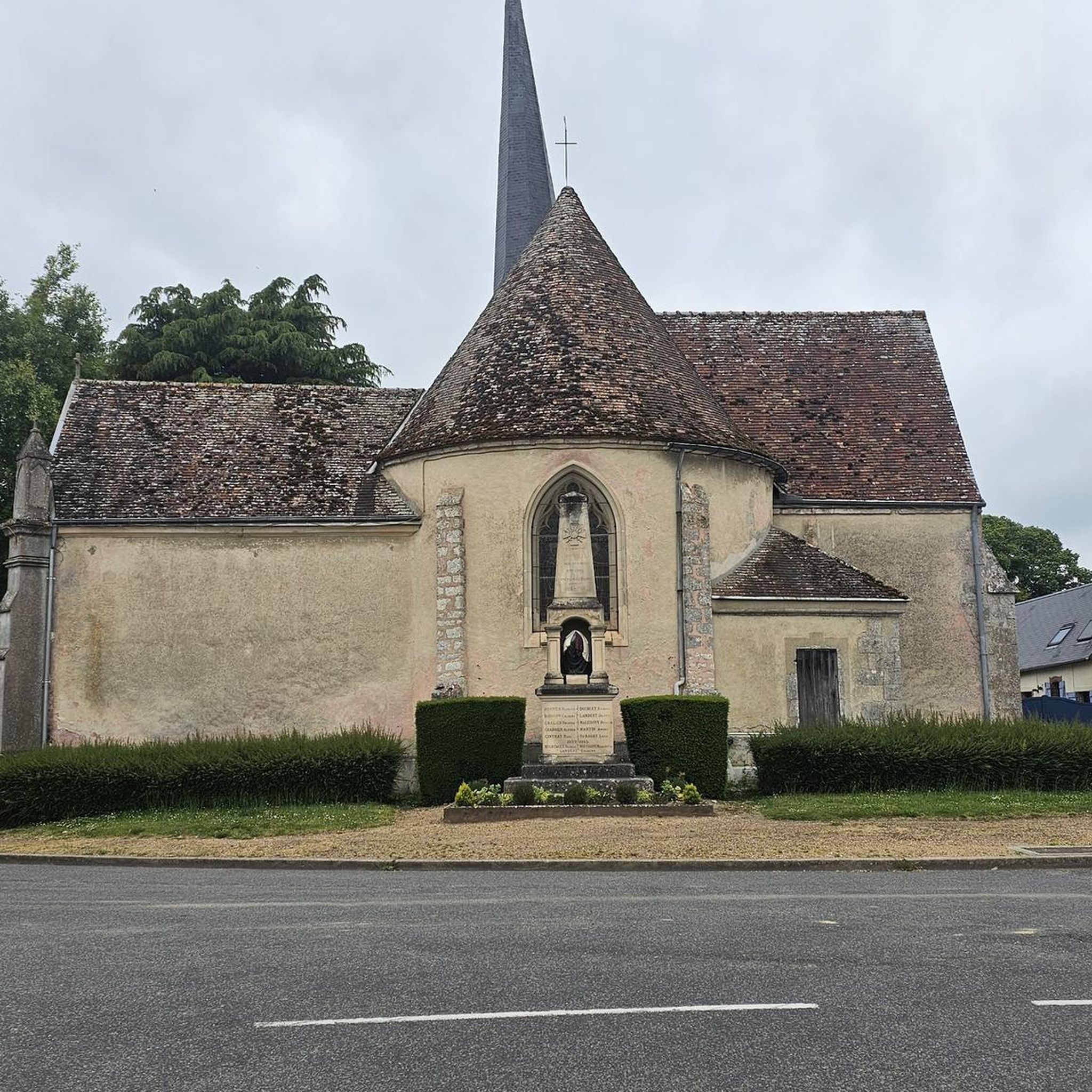
The nave ends with an apse with facets, all covered by a polygonal paneled frame. A bell tower surmounts the facade. The current church was almost entirely rebuilt or renovated in the 17th century. The framework is entirely from this period. The underside of the rafters forming the truss and the turned-up tie beams is adorned with shingles decorated with decorative paintings. This framework is one of the rare examples entirely from the 17th century. Under Louis XIV, camps were established in the Gallardon valley for the construction of the Maintenon aqueduct. Officers stayed in the surrounding castles, and an intense life, with visits from the court, reigned in this region. It is likely that this church was completely restored at that time, and enriched with paintings in the style of the time.
0
0
The Saint-Léger church of Houx is a religious monument located in the commune of Houx, in the Centre-Val de Loire region. Although its existence is attested, the available sources do not specify either its period of construction or the architectural or historical details associated with it. This type of building, typical of small French towns, often plays a central role in local life, both spiritually and communally. In the Centre-Val de Loire, parish churches like Saint-Léger of Houx were historically essential gathering places for the inhabitants. They served not only for religious services, but also for social or civic events. Their presence generally reflects the medieval or modern organization of the villages, where the church constituted a major geographical and identity landmark.
0
0
The church of Bleury, dedicated to Saint Martin, probably dates from the end of the Middle Ages. It was remodeled and enlarged in the 16th century by the addition of a large chapel on the north side. The nave ends with a semicircular apse. The chapel to the north is extended by a square bell tower which once opened onto the nave through an arch that is now blocked but still visible. The chapel opens onto the nave through two pointed arches made of recently rendered clotted stone. It communicated with the ground floor of the courtyard through an arch that is now closed. Another filled-in arch appears on the wall between the chapel and the lower room of the courtyard. The church is covered with a paneled roof. A single beam is sculpted, the penultimate one on the west side. It supported, with the beam resting on the facade wall, a recently demolished gallery. Some of the nave's semi-circular windows are late, and the pointed arch openings have Gothic tracery. The square bell tower has a saddleback roof. It is pierced with pointed arch openings. Access to the building is from the south, under a modern porch that houses a portal surmounted by a shield with three fleurs-de-lis. A stone cornice runs under the roof to the south, supported by unsculpted modillions. Two 18th-century altarpieces were included in the Supplementary Inventory of Historic Monuments on June 17, 1975. 16th-century wall paintings depict the Mass of Saint Gregory. They were discovered in 1881 and classified as Historic Monuments on November 17, 1908. Their preservation is currently threatened by infiltration due to the poor condition of the roof structure. The Sauvegarde de l’Art Français provided aid of 75,000 F in 1994, thus contributing to the repairs undertaken to restore the framework, which will allow the walls to be cleaned up.
0
0
Saint-Martin Church. This extremely modest church consists of a four-bay nave extended by a three-sided apse to the east and a sacristy to the north. It is built of rubble block, with sandstone buttresses and shell limestone surrounds. Although its history is poorly documented, it is likely that an earlier 16th-century church was enlarged and modified in the 18th and early 19th centuries. Externally, its elevation is punctuated by a short timber-framed bell tower erected in 1889-1890 above the western bay of the nave. The western façade is late: it features an 18th-century arched doorway, with the first level lit by three unequal pointed-arch windows, an addition made in 1820. On the south façade, a stone cornice runs under the roof, while a drip edge stringcourse is located one meter above the ground. Two of the apse windows were blocked during the installation of the great altarpiece. In 1890, when the spire was moved, the first bay of the nave underwent some modifications: the western wall was lined internally with another wall in which three large arches were cut; in the space thus delimited, two chapels were created on the ground floor, on either side of the entrance door, and a small gallery on the first level, while a staircase provided access to the bell tower. The interior of the church was furnished and decorated in the late 18th century. and during the Restoration: the Visitation altarpiece (1815-1820) dates from this period. Some statues, including four wooden evangelists, came from the old tabernacle. Statues of Saint Martin and Saint James were placed in the side niches of the altarpiece. The Sauvegarde de l'Art français (French Art Protection Agency) contributed €30,490 to the roofing work on the building in 2002.
1
0
The building dates from the 12th century and saw the addition of a side bay in the 16th century. On Monday, November 16, 1733, the church's small bell, weighing 557 and a half pounds (approximately 277 kg), was blessed. It is dedicated to Saint Martin, patron saint of the parish.
0
0
Frequently Asked Questions
How many road cycling routes are available around Houville-La-Branche?
There are over 270 road cycling routes around Houville-La-Branche, offering a wide variety of options for different skill levels and preferences. You'll find everything from easy loops to more challenging rides.
What kind of terrain can I expect on road cycling routes near Houville-La-Branche?
The region offers diverse terrain. You'll encounter the expansive, agricultural plains of the Beauce, known for mostly flat roads, as well as the more undulating, green hills of the Perche. Many routes also follow tranquil river valleys, such as the Eure and Loir, providing a mix of scenery and elevation profiles.
Are there any notable landmarks or natural features to see along the road cycling routes?
Yes, road cycling routes around Houville-La-Branche offer several points of interest. You can cycle past the historic Château de Houville-la-Branche with its magnificent 50-hectare park. Many routes also lead towards Chartres, where you can visit the famous Chartres Cathedral, a UNESCO World Heritage site. The routes often traverse charming villages and offer scenic views of the Eure and Loir river valleys.
When is the best time of year for road cycling in Houville-La-Branche?
The spring and autumn months generally offer the most pleasant conditions for road cycling in Houville-La-Branche, with milder temperatures and beautiful scenery. Summer can also be excellent, though it's advisable to start earlier in the day to avoid the midday heat. The region's well-maintained roads are generally accessible year-round, but winter rides may require appropriate gear for colder weather.
Are there family-friendly road cycling routes suitable for all ages?
Yes, the region offers several easy road cycling routes that are suitable for families. These routes often feature gentle elevation profiles and pass through quiet agricultural fields and small villages. For example, the Chamblay Village – Église de Corancez loop from Nogent-le-Phaye is an easy 30.7 km trail that is popular for its accessible nature.
What are some popular longer-distance cycling routes accessible from Houville-La-Branche?
Houville-La-Branche is strategically located near major long-distance cycling itineraries. You can access sections of the renowned Veloscenic (La Véloscénie), which connects Paris to Mont-Saint-Michel, with a significant portion passing through Eure-et-Loir via Chartres. The Loir Valley by Bike (La Vallée du Loir à Vélo), a 320 km route following the Loir river, also offers a gentler, picturesque cycling experience.
What do other road cyclists enjoy the most about road cycling in Houville-La-Branche?
The area is highly rated by the komoot community, with an average score of 4.3 stars from over 80 reviews. Reviewers often praise the varied terrain, from quiet agricultural plains to scenic river valleys, and the well-maintained roads. The accessibility to charming villages and historical landmarks like Chartres also contributes to a highly enjoyable cycling experience.
Are there any circular road cycling routes available?
Yes, many of the road cycling routes around Houville-La-Branche are designed as circular loops, allowing you to start and finish at the same point. Examples include the moderate Esclimont Castle – Armenonville church loop from Champseru, or the scenic Lavoir de Soulaires – Spot for a break on the banks of the Eure loop from Francourville, which follows the Eure river.
Can I find routes that offer a good balance of distance and elevation?
Absolutely. The routes around Houville-La-Branche cater to various fitness levels. For a moderate challenge, consider the Esclimont Castle – Gourville fortified manor loop from Francourville, which covers over 51 km with around 240 meters of elevation gain. This provides a good workout while allowing you to enjoy the diverse landscapes.
Are there routes that focus on riverside scenery?
Yes, several routes are designed to showcase the tranquil beauty of the local rivers. The Lavoir de Soulaires – Spot for a break on the banks of the Eure loop from Francourville is a prime example, offering scenic views along the Eure river. The broader Loir Valley by Bike route also emphasizes riverside cycling through preserved natural settings.
What are the options for more challenging road cycling routes?
While the region is known for its generally gentle terrain, there are routes that offer more significant challenges. You can find routes with up to 500 meters of elevation gain, often traversing the more undulating parts of the Perche region. These routes provide a good test for experienced cyclists looking for longer distances and more climbing.
Where can I find more information about cycling in the Eure-et-Loir department?
For additional information on cycling opportunities and routes within the broader Eure-et-Loir department, you can visit the official tourism website. They provide details on various cycling experiences, including the Veloscenic route. You can explore more at tourisme28.com/en/cycling/.
Most popular routes around Houville-La-Branche
Most popular attractions around Houville-La-Branche

Get inspired with the komoot mobile app


Explore more
Browse the best Road cycling routes in other regions.
