The best road cycling routes around Le Gault-Saint-Denis
4.6
(28)
342
riders
136
rides
Road cycling routes around Le Gault-Saint-Denis are situated in the Eure-et-Loir department of the Centre-Val de Loire region of France. This rural commune offers access to diverse landscapes, including the vast open plains of Beauce, known for long, unobstructed stretches. The region also features the rolling hills of Perche and picturesque river valleys, such as the Loir Valley, providing varied terrain for cyclists. The area's cycling infrastructure supports exploration across different fitness levels.
Best road cycling routes around Le Gault-Saint-Denis
…Last updated: July 2, 2026
3.0
(1)
23
riders
Moderate road ride. Good fitness required. Mostly well-paved surfaces and easy to ride.
10
riders
Easy road ride. Great for any fitness level. Mostly well-paved surfaces and easy to ride.

Sign up for free
8
riders
11.2km
00:27
50m
50m
Easy road ride. Great for any fitness level. Mostly well-paved surfaces and easy to ride.
6
riders
52.2km
02:01
130m
130m
Moderate road ride. Good fitness required. Mostly well-paved surfaces and easy to ride.
5
riders
Easy road ride. Great for any fitness level. Mostly well-paved surfaces and easy to ride.
Get access to more routes and recommendations from other explorers.
Sign up for free
Already have an account?
Our route recommendations are based on thousands of hikes, rides, and runs completed by other people on komoot.
Start today with a free account
Your next adventure awaits.
Login or Signup


Tips from the Community

The oldest document mentioning the Church of Saint-Martin in Fresnay-le-Comte is the charter of Renaud de Mouçon, Bishop of Chartres, confirming the possessions of the Abbey of Marmoutier, near Tours. This charter dates only from the last years of the 12th century, but the church's foundation may have already existed at that time. The building comprises two parts of roughly equal size and from different periods. The older part, roughly corresponding to the nave, is of a rather undefined style. The west portal, with its pointed arch devoid of any decoration, may date back to the 12th or 13th century, as may the first window of the nave, on the right. In the north wall, there is a small, walled-up doorway, whose lintel, adorned with an accolade, is no earlier than the 15th century, but the relieving arch above it appears older, perhaps from the 12th century. Half of the church, including almost the entire chancel, is from a more recent period and easily recognizable. The polygonal apse and the windows with their flamboyant tracery of late design indicate the very end of the 15th century. An inscription on one of the chancel's tie beams gives a precise date: In the year 1529, this chancel was completely rebuilt. The statue of the Virgin Mary was baptized during the Mass of October 30, 2021, by Father Pierre Paul. This statue, moved from the Chapel of the Three Marys in Mignières, was restored by Mr. Martial Moulin, a sculptor from Chartres.
0
0
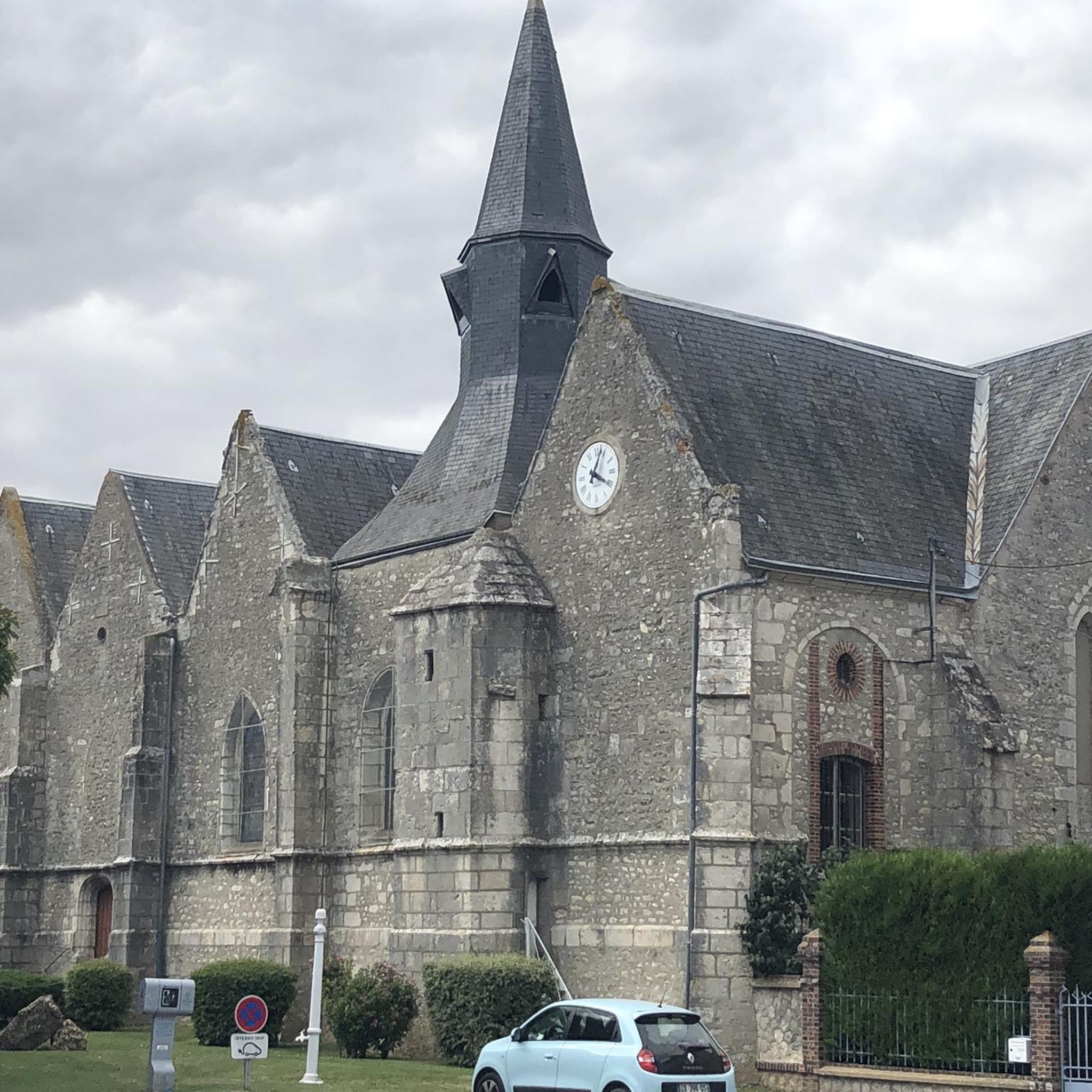
The church, dedicated to Saint Denis, is located in the diocese of Chartres. It was under the jurisdiction of the Benedictine abbess of Saint-Avit in Châteaudun. It comprises two distinctly contrasting parts: a low Romanesque nave, 17 meters wide by 8.5 meters long, and a taller Gothic chancel, 14 meters wide by 10 meters long. The western doorway, with its semicircular arch, is framed by columns whose bases are molded with two tori and whose capitals are adorned with leaves ending in volutes. The tympanum is plain, surrounded by a molded archivolt, and externally highlighted by an archivolt decorated with a sawtooth pattern, similar to that of the nearby church of Saint-Maur-sur-le-Loir. The western gable, framed by flat buttresses, is pierced above this doorway only by a small semicircular window. The nave's side walls are reinforced with buttresses. The north buttress is blank, while the south one has three windows, two of which, long and narrow, may be original; the third was likely widened later. A side door was added on this side in the 14th century. The chancel, with its flat apse, is topped by a high gable whose sloping sides are decorated with crockets. The central window with flamboyant tracery was walled up to accommodate the large altarpiece. The north wall is blank; only two flamboyant windows with triple lancets illuminate this part of the building on the south side. The structure is punctuated by flat buttresses with offsets. A stone inscription indicates the date of its construction: 1550. Inside, the nave and chancel are not vaulted in stone, as the large number of buttresses might suggest from the outside. They are covered with panelled wooden vaults. In the center of the nave, four wooden pillars and a hexagonal framework support the slate spire that crowns the building. Among the interesting furnishings are a 17th- or 18th-century baptismal font, a painting depicting the Education of the Virgin, a pulpit, a churchwarden's pew, choir stalls, Restoration-era choir paneling, and, most notably, a magnificent and imposing altarpiece from the church of Saint-Germain-les-Alluyes, from where it was transferred in 1812. It is the work of Charles Roscoët, who also worked at the churches of Alluyes and Moriers. The Vitray altarpiece dates from 1669; its central panel is framed by double twisted columns adorned with vine leaves and surmounted by a Baroque pediment in the center of which is a statue of a bishop saint (Saint Germain) between reclining figures. The two wings of the altarpiece, right and left, are topped with twisted columns and adorned with shell-shaped niches intended to hold statues. In 2005, the French Heritage Society (Sauvegarde de l’Art français) awarded a grant of €6,500 for the restoration of the gable, the belfry, and the bell tower roof, as well as the installation of a lightning rod.
0
0

This church in Meslay-Le-Vidame, whose architecture reflects the formal language of antiquity, was dedicated to the patron saint of Saint Etienne. He was one of the first seven deacons of the original Jerusalem church and, according to the biblical accounts in the New Testament, the first martyr (martyr) of early Christianity. The church commemorates his death on Boxing Day, December 26th. As the Acts of the Apostles recounts: When Stephen recounted his vision of the open heavens, "And he, full of the Holy Spirit, looked up into heaven and saw the glory of God, and Jesus standing at the right hand of God" (Chapter 7, Verse 55), the people were so outraged that they drove him out of the city and stoned him.
0
0

Unfortunately, the church was not accessible when I visited (mid-September 2024). You could only look in through a gate and the dance of death depictions on the left side were not really visible. In front of them were transparencies with skeleton drawings. Maybe those were the depictions...
0
0
Historically, our small medieval Romanesque church, dedicated to Saint Silvanus, was an integral part of a lordship. We can, still today, guess the vestiges of the seigniorial coat of arms on the liter (the banner) located just below the windows on the north face. Located near the old castle moat, the cemetery flanked it, on the north side in place of the current car park and the multi-purpose room, on the south side at the level of the green space currently planted with lime trees. Originally only the central building existed and the bell tower topped it in its center. This is the reason why at the beginning of the 1980s, the framework began to collapse, weakened by the weight and the marks of time left by the old bell tower. This renovation proved, if necessary, through the design of the framework, the existence of the central bell tower. The time when the bell tower was moved off-center is at the end of the 16th century, beginning of the 17th century. Concerning the creation of the sacristy and the side chapels, the departmental archives hold a plan of the church, dated August 19, 1853 which clearly indicates the existence of the sacristy and only the north chapel, the construction of the South chapel was therefore not concomitant. In the masonry, the small Romanesque windows can still be seen, the only one remaining, unwalled, opens to the east and still today offers a light entrance into the apse. Around the church we notice two types of buttresses, the first, the narrower ones date from the creation of the building, the more massive ones date from the 18th century, placed as reinforcements Neo-classicism at the end of the 18th century and the beginning of the 19th century left its mark on this building. Outside, as we have seen, by the addition of the sacristy as well as the small side chapels now forming a transept.
0
0
Thivars is mentioned in 966 in the Chartres cartulary. In the 12th century, the church became the property of Josaphat Abbey. The current church was built in the 16th century: a date of 1545 is engraved on a cherub in the turret. It is a very high construction but very irregular, this comes from the fact that it belongs to several eras: ogival style in the windows, the entrance door is Romanesque (it may be the door of the first Romanesque church) . The choir was formerly separated from the nave by an iron grille which disappeared during the French Revolution. The ceiling has pretty paneling dating from 1645. The two side altars are dedicated: one to Notre Dame des Victoires and the other to Saint Joseph. Among the furniture we can note an interesting painting which represents Our Lord pronouncing on a coin. In 1940, two bombs fell less than 30 m from the church, destroying the stained glass windows on the south side which were replaced by grisailles in 1987. Three pretty stained glass windows light up this church: Nativity stained glass window installed by Mr Campin in 1955 Stained glass windows of the village's patron saints, Saint Radegonde and Saint Hilaire, installed in 1900 and 1987 respectively.
1
0

The walls of the nave of the church of Saint-Orien are adorned with paintings from the 15th century, which are surprisingly well preserved. They represent a dance of death, symbolizing the confrontation between humans and death. To have !
2
0

these paintings are quite exceptional and deserve to be appreciated by visitors passing through or not.
0
0
Frequently Asked Questions
What kind of terrain can I expect when road cycling around Le Gault-Saint-Denis?
The region offers a diverse landscape for road cyclists. You'll find vast, open plains in the Beauce area, providing long, unobstructed stretches. In contrast, the Perche region features more undulating, rolling hills, offering varied gradients and scenic rides through wooded environments. The Loir Valley provides picturesque routes, often alongside rivers, with gentler inclines.
Are there road cycling routes suitable for beginners or families in Le Gault-Saint-Denis?
Yes, Le Gault-Saint-Denis and the surrounding Eure-et-Loir department offer routes suitable for various fitness levels, including easier options. For example, the Eglise le Gault Saint Denis – Winding Road Through Fields loop from Le Gault-Saint-Denis is an easy 24.1 km trail through open fields, ideal for a more relaxed ride. Another easy option is the Eglise le Gault Saint Denis loop from Le Gault-Saint-Denis, which is just over 11 km.
What are some longer or more challenging road cycling routes in the area?
For those seeking a longer or more challenging ride, the region has options with significant distances and elevation gains. The Château de Châteaudun – Bonneval loop from La Bourdinière-Saint-Loup is a moderate 118 km path that offers a substantial ride through varied terrain, including views of historical towns. The broader Eure-et-Loir region also features challenging routes like the 'LOVE TOUR', a 184.4 km route with 770 meters of ascent, indicating opportunities for experienced cyclists.
What historical towns or landmarks can I explore along the road cycling routes?
The region is rich in historical and cultural points of interest. You can cycle through or near charming towns like Bonneval, known for its fortifications and the Loir river. Other notable attractions include the Porte de Boisville, Alluyes Castle, and the Saint-Étienne Church of Meslay-le-Vidame. The Ancient City Gate of Bonneval is also a significant historical site.
Are there any circular road cycling routes available?
Yes, many of the road cycling routes around Le Gault-Saint-Denis are designed as loops, allowing you to start and end in the same location. Examples include the popular Ponds of Fontenay sur Eure – The Eure at Ver les Chartre loop from La Bourdinière-Saint-Loup, a 59.3 km route, and the Église de Corancez – Chamblay Village loop from La Bourdinière-Saint-Loup, which covers 52.1 km.
What is the best time of year for road cycling in Le Gault-Saint-Denis?
The Eure-et-Loir region generally offers pleasant cycling conditions for much of the year. Spring and autumn provide mild temperatures and beautiful scenery, making them ideal. Summer can also be excellent, though it's advisable to start earlier in the day to avoid the midday heat. The open plains of Beauce can be exposed to wind, so checking weather forecasts is always recommended.
How many road cycling routes are available around Le Gault-Saint-Denis?
There are over 140 road cycling routes available around Le Gault-Saint-Denis on komoot, catering to a wide range of abilities. This includes approximately 50 easy routes, 80 moderate routes, and a few more difficult options for experienced cyclists.
What do other road cyclists say about the routes in Le Gault-Saint-Denis?
The road cycling routes in Le Gault-Saint-Denis are highly rated by the komoot community, with an average score of 4.9 stars from over 20 reviews. Cyclists often praise the varied terrain, from open fields to rolling hills, and the opportunities to explore charming villages and historical sites. Over 300 road cyclists have used komoot to explore the area's diverse network.
Are there any specific permits required for road cycling in the Eure-et-Loir region?
Generally, no specific permits are required for road cycling on public roads and designated cycling paths in the Eure-et-Loir region. You are free to explore the network of routes. However, always respect local regulations and private property signs.
Can I find cafes or places to stop for refreshments along the routes?
While Le Gault-Saint-Denis is a rural commune, the surrounding towns and villages, especially those featured on longer routes like Bonneval, offer opportunities for refreshments. Planning your route to pass through these settlements will allow you to find cafes, bakeries, or small shops to refuel during your ride.
Is it possible to combine road cycling with public transport in the Le Gault-Saint-Denis area?
Connecting with public transport can be an option, especially if you're looking to extend your range or reach starting points further afield. While direct public transport links within Le Gault-Saint-Denis itself might be limited, the Eure-et-Loir department is part of a regional network. It's advisable to check specific train or bus services for their bike carriage policies and schedules, particularly for routes connecting to larger towns like Chartres.
Where can I find more information about cycling in the Eure-et-Loir department?
For broader information on cycling opportunities and infrastructure within the Eure-et-Loir department, you can visit the official tourism website for the region. They often provide details on cycling routes, events, and services. You can find more information at tourisme28.com.
Most popular attractions around Le Gault-Saint-Denis

Get inspired with the komoot mobile app


Explore more
Browse the best Road cycling routes in other regions.
