The best road cycling routes around Fessanvilliers-Mattanvilliers
4.7
(54)
383
riders
155
rides
Road cycling routes around Fessanvilliers-Mattanvilliers traverse a tranquil, rural commune in the Eure-et-Loir department of France. The region is characterized by gently undulating agricultural landscapes and some forested areas, with an average altitude of approximately 175 meters. This topography provides a network of quiet, paved roads suitable for road cycling, featuring gentle inclines rather than challenging climbs. The nearby Avre Valley offers scenic routes through verdant countryside.
Best road cycling routes around Fessanvilliers-Mattanvilliers
- The most popular road cycling route is…
Last updated: November 2, 2026
2
riders
Easy road ride. Mostly well-paved surfaces and easy to ride.
4.0
(3)
7
riders
28.1km
01:22
170m
170m
Easy road ride. Mostly well-paved surfaces and easy to ride.

10
riders
87.9km
03:54
360m
360m
Moderate road ride. Good fitness required. Mostly well-paved surfaces and easy to ride.
8
riders
32.6km
01:25
270m
270m
Easy road ride. Mostly well-paved surfaces and easy to ride.
4
riders
27.6km
01:05
100m
100m
Easy road ride. Mostly well-paved surfaces and easy to ride.
Get access to more routes and recommendations from other explorers.
Already have an account?
Our route recommendations are based on thousands of hikes, rides, and runs completed by other people on komoot.
Start today with a free account
Your next adventure awaits.


Tips from the Community

Very nice
0
0
Very good for taking photos
0
0

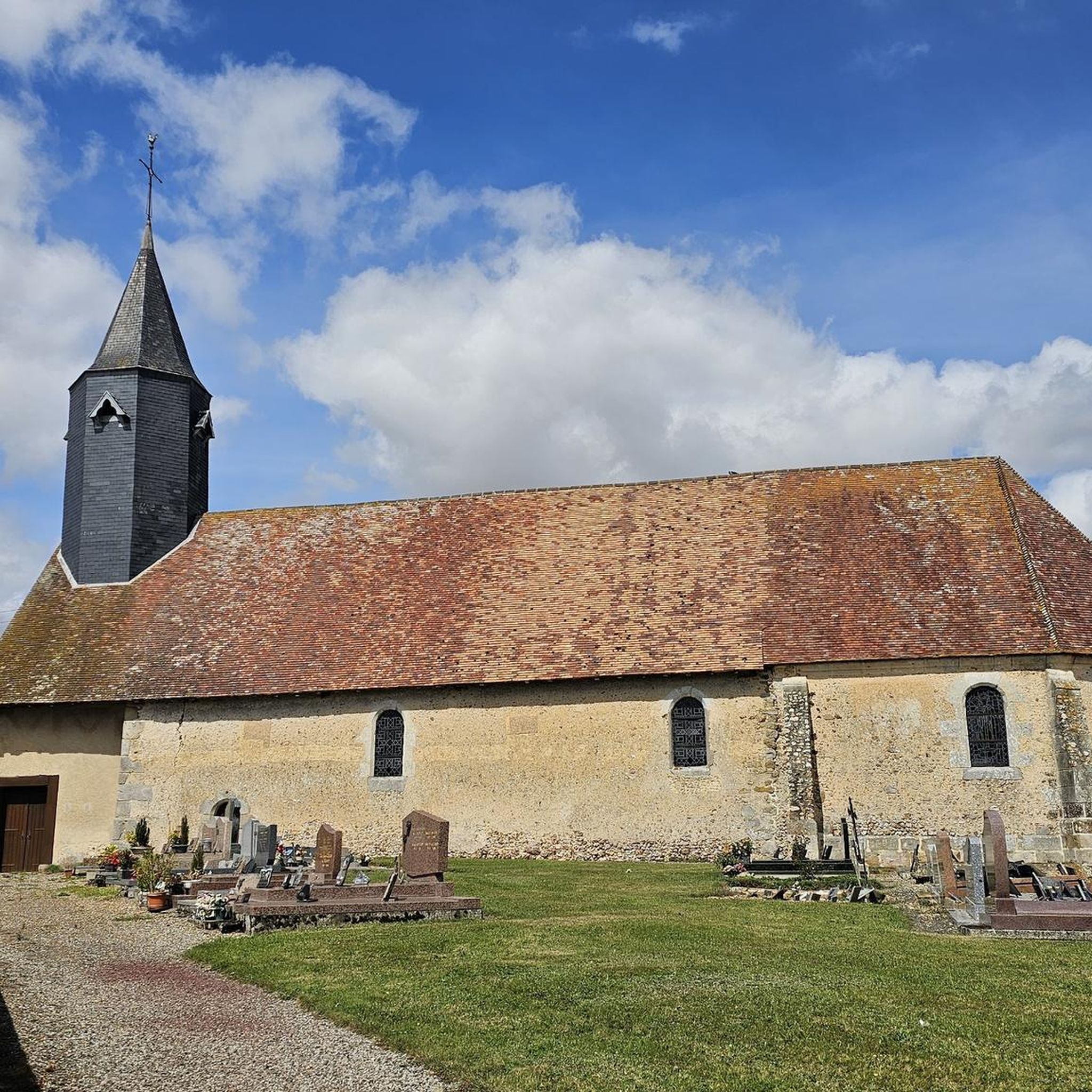
South of the Eure department, the village of Saint-Ouen-d'Attez dates back at least to the Gallic occupation, Attez coming from the Gaulish term for "rural house." The church of Saint-Ouen has been documented since the early 12th century. While Romanesque remains remain on the west gable, buttresses, and section of the north wall, it was largely rebuilt in the 16th century in the Flamboyant Gothic style, with the nave, choir, and the addition of the south aisle, formed by four side chapels with vaulted bays. The bell tower was built in the late 17th century, and extensive restoration work was carried out in the 19th century. It is also worth noting that a charity chamber housed the Charity Brotherhood of Saint Barbara, founded in 1736. Banners and clothing belonging to this brotherhood can be seen in the church. A large number of graffiti and devotional crosses can also be seen on the church, the oldest of which date back to at least the 17th century. The small room attached to the west gable, in line with the south aisle, could correspond to a Charity Room. In the early 1980s, the choir roof had collapsed and the municipal council voted by a majority vote to carry out a phase of restoration work on this choir, otherwise the church would have been closed and abandoned.
0
0
The church is located near a departmental road and is surrounded by a cemetery. Church oriented with a longitudinal plan composed of a single nave. The entrance to the building is via a porch body. An annex building is attached to the north side of the choir. The western facade of the porch body rises on two levels delimited by a projecting cornice. It is pierced by a low-arched door as well as a rose window in the upper part. The bell tower, of polygonal plan, is positioned on the ridge of the roof. It is covered with a polygonal spire surmounted by a ridge cross and has two roof eaves. The building is covered with a gable roof. That of the annex building ends in a hip. The side walls are pierced with arched bays and supported by buttresses. The annex building is pierced by a quadrangular window and door. The buttresses of the choir bear witness to the Romanesque origins of the church. The nave, built in the 16th century, was enlarged in the 19th century by a bay to the west. The bays of the building were re-pierced around 1822.
0
0
Saint-Pierre Church. The village is spread out over the Douze valley. The church, of large dimensions, is composed of two chronologically distinct parts: a Romanesque nave and, on the other hand, a false transept and a 16th century choir. Although the nave is not vaulted, it is supported by three almost flat buttresses which divide it into three "bays". The oldest parts of the construction seem to be the western part of the nave and a portion of the herringbone wall. The hypothesis of the Drouais and Thimerais Archaeology Society would be that the choir and the south chapel date from the 15th century and the north chapel from the 16th century. According to the Archaeological Society of Eure-et-Loir, all the transformations date from the 16th century: we would be inclined to agree with this latter opinion, given the size of the south chapel and the coherence of the whole of the eastern part of the church, particularly highlighted by the presence of a vigorous dripstone cordon that underlines the base of the building, structuring the elevation all around the chevet and the two chapels. The two chapels forming a transept are lit by two large windows: those of the south chapel are in a pointed arch, divided by a tracery into two lancets and a polylobed arch, perhaps traced during a later restoration. Three sculpted buttresses support this elevation, two were placed at the corners, the third between the two windows that light the chapel to the south. The applique of the west wall of the south chapel is very neat. The upper part of the south gable wall has been rebuilt, but the base in the lower part is also carefully dressed. The chevet built in fine stone is also supported by elegant buttresses. However, it is the chapel built symmetrically to the north that appears to be the most refined by the quality of its limestone with live joints, by the design of the buttresses and the tracery of the large windows. On the north side, the "door of the dead" communicating with the cemetery, was pierced on the west wall of the chapel. It is surmounted by a pediment, the jambs are decorated with pilasters, not protruding. It is certainly a seigneurial chapel. We enter the church by the west door under an 18th century porch covered with a beautiful frame. The door is also old. At the entrance to the church, we find ourselves under the stool of the frame spire. There may be remains of ancient decorations under the whitewash of the nave. A beam of glory separates the nave from the choir: it is a complete polychrome wooden ensemble, Christ on the cross surrounded by the Virgin Mary and Saint John and below, the Virgin of Pity. The work bench has been preserved. Inside the north chapel, we can see at the corners bundles of ribbed vaults which seem to be waiting for a vault which may have collapsed, or, more likely, which was never erected. In the south wall is embedded a pile whose capital, with an angel's head, bears the barely legible date of 1514. The high altar, from the 18th century, in carved wood, has been preserved in place; the painting of the altarpiece represents the denial of Saint Peter. The fragments of stained glass from the 16th century were removed during the work. The church preserves a wooden Education of the Virgin, split, a Saint Peter, a Saint George, a Saint Sebastian, a naïve Saint Eligius. The Sauvegarde de l’Art français granted aid of €5,000 in 2005 for drainage, masonry and framework repairs and tile roofing.
0
0

Église Saint Madeleine is a church where beautiful various statues of Saints, famous and less famous. The reason for so many different statues is that the school of sculpture was established here.
0
0
church with special bell tower: octagonal on a square base
0
0
Frequently Asked Questions
What kind of terrain can I expect on road cycling routes around Fessanvilliers-Mattanvilliers?
The region around Fessanvilliers-Mattanvilliers is characterized by gently undulating agricultural landscapes and some forested areas. You'll find a network of quiet, paved roads with gentle inclines, making for a pleasant road cycling experience without challenging climbs. The scenic Avre Valley also offers verdant countryside routes.
How many road cycling routes are available in the Fessanvilliers-Mattanvilliers area?
There are nearly 170 road cycling routes available around Fessanvilliers-Mattanvilliers. These routes cater to various skill levels, from easy loops to more moderate distances.
Are there routes suitable for beginners or those looking for an easy ride?
Yes, the area offers a good selection of easy routes. You'll find over 40 easy road cycling routes, such as the From Brezolles to Saulnières — loop via the Châteaux d'Escorpin and Maillebois, which is an easy 28.9-mile trail, or the Saint-Hilaire Church – Le Trianon Cinema loop from Tillières, an easy 17.5-mile path.
What are the best times of year for road cycling in Fessanvilliers-Mattanvilliers?
The Eure-et-Loir department, where Fessanvilliers-Mattanvilliers is located, is ideal for cycling during spring, summer, and early autumn. These seasons offer pleasant weather for exploring the tranquil countryside and enjoying the natural beauty of the Avre Valley.
What notable landmarks or attractions can I see along the road cycling routes?
Many routes pass through charming rural settlements and offer glimpses of local churches. For more significant historical sites, consider routes that lead towards the nearby town of Verneuil-d'Avre-et-Iton. Here you can explore attractions like the impressive La Madeleine Church, the historic Gray Tower, or the Medieval town centre of Verneuil-sur-Avre. Some routes, like the From Brezolles to Saulnières loop, even pass by historical châteaux such as Château de Maillebois.
Are there any circular road cycling routes available?
Yes, many of the road cycling routes in the Fessanvilliers-Mattanvilliers area are designed as loops, allowing you to start and finish at the same point. Examples include the From Brezolles to Saulnières loop and the Route des Roches – Iton River loop from Tillières-sur-Avre.
What do other road cyclists enjoy most about cycling in Fessanvilliers-Mattanvilliers?
The area is highly rated by the komoot community, with an average score of 4.7 stars from over 40 reviews. Cyclists often praise the tranquil, rural atmosphere, the quiet paved roads, and the scenic beauty of the Avre Valley and surrounding agricultural fields.
Are there options for longer or more moderate road cycling tours?
Absolutely. While the terrain is generally gentle, there are over 120 moderate routes available for those seeking longer distances. For example, the Route des Roches – Iton River loop from Tillières-sur-Avre is a moderate 54.5-mile trail that takes about 3 hours 51 minutes to complete.
Is it possible to rent bikes in or near Fessanvilliers-Mattanvilliers?
While Fessanvilliers-Mattanvilliers is a small commune, the wider Eure-et-Loir region is cycling-friendly. Some local accommodations in the area are known to offer bikes to discover the tracks of the Avre Valley. It's advisable to check with local tourist information or accommodations in nearby towns for specific rental options.
What kind of natural features will I encounter on the routes?
You will primarily encounter agricultural landscapes, small forested areas, and the picturesque Avre Valley. The Eure-et-Loir region is known for its diverse scenery, including rolling hills and routes along riverbanks, providing a peaceful and authentic French countryside experience.
Are there any challenging road cycling routes in the area?
While the region is known for its gentle terrain, there are a couple of routes classified as difficult for those seeking a greater challenge. These routes will typically feature longer distances or more sustained inclines compared to the easy and moderate options.
Where can I find more information about the Eure-et-Loir region for cycling?
For broader information about cycling in the Eure-et-Loir department, including other routes and general cycling tips for the region, you can visit the official tourism website: tourisme28.com/en/cycling/.
Most popular routes around Fessanvilliers-Mattanvilliers
Most popular attractions around Fessanvilliers-Mattanvilliers

Get inspired with the komoot mobile app


Explore more
Browse the best Road cycling routes in other regions.
